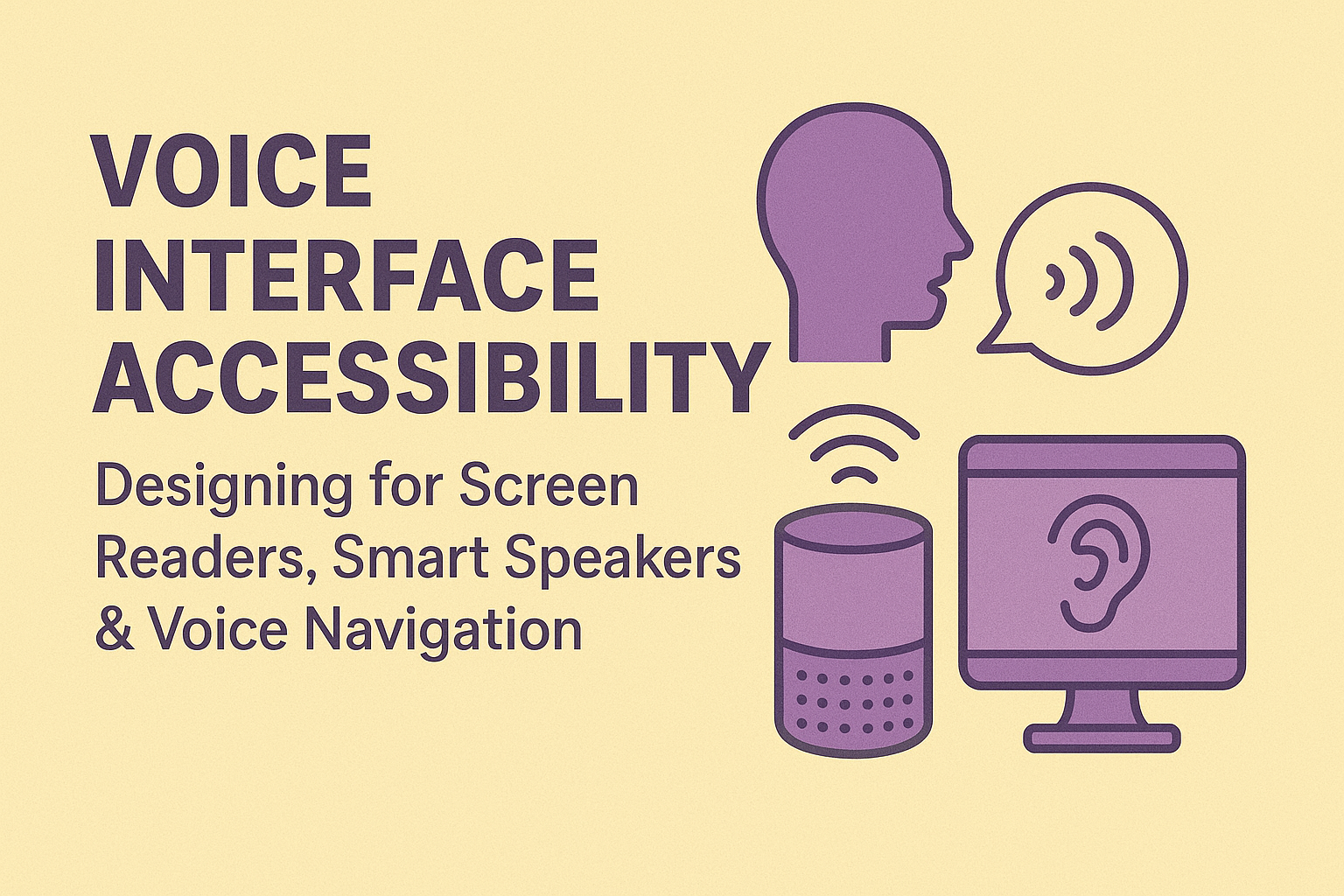
Voice Interface Accessibility — Designing for Screen Readers, Smart Speakers & Voice Navigation
Voice Interface Accessibility — Designing for Screen Readers, Smart Speakers & Voice
Navigation
Introduction
Voice interfaces are transforming how users interact with digital systems — from smart speakers and virtual assistants to screen readers and voice-controlled mobile apps. For many users with mobility, vision, or cognitive challenges, voice navigation turns technology into an empowering tool. However, if not designed inclusively, these experiences can exclude the very people who benefit most. Accessible voice design ensures that spoken interactions are perceivable, operable, and understandable for everyone.
This guide explores how to design accessible voice interfaces following WCAG and W3C Voice User Interface (Voice UI) best practices.
Why Voice Interface Accessibility Matters
- Voice interfaces provide alternative input and output methods beyond keyboards, mice, or touch screens.
- Screen readers and speech recognition assistive tools rely on clear, structured markup for interpretation.
- Voice-based control can improve efficiency and independence for users with visual or motor impairments.
Accessibility for voice interfaces means ensuring both the voice input and the spoken or visual responses are inclusive and logically structured.
Key Principles of Accessible Voice UX
1. Clarity & Context
Voice prompts should clearly describe what users can do next, using concise, familiar language. Avoid ambiguous terms or complex commands.
2. Predictability & Consistency
Use a consistent tone and pattern for responses. Predictability helps users form mental models and avoids confusion.
3. Error Prevention & Recovery
Guiding users through mistakes without frustration is essential. Confirm inputs before performing irreversible actions, and provide nonjudgmental feedback.
4. Multiple Confirmation Channels
Offer both visual and auditory confirmation when possible to assist multi-modal users and ensure redundancy.
Designing Accessible Voice Navigation for Web & Apps
Voice-controlled navigation is increasingly integrated with operating systems and browsers (e.g., Voice Access on Android, Siri Shortcuts, or Windows Speech Recognition). To support these tools:
- Use clear, descriptive labels and ARIA roles on actionable elements (buttons, links, controls).
- Ensure each interactive element has a unique name and contextual description (e.g., “Submit Order Button”).
- Maintain logical focus order so screen readers and voice navigators can follow the same path as visual users.
- Support native HTML controls over custom ones for maximum compatibility with assistive technologies.
Screen Reader Voice Interaction
Screen readers convert text and structure into spoken output. Your markup should communicate roles, states, and relationships so that voice feedback matches user expectation.
<button aria-label="Search Products">
  <svg aria-hidden="true"></svg>
</button>
- Never use icons alone without ARIA labels for actions.
- Announce real-time updates with
aria-liveregions for dynamic pages or voice responses to actions. - Confirm context (e.g., “Dialog open: Filter Options”) to orient users after commands.
Voice Interface Accessibility for Smart Speakers
Smart speakers (e.g., Amazon Alexa, Google Assistant) rely on voice-only interaction. Accessibility means designing for conciseness, context awareness, and discoverability.
- Use short, clear invocation phrases (e.g., “Alexa, Accessibility Tips”).
- Offer progressive disclosure — don’t list five options when two are available right now.
- Provide help and repeat commands (e.g., “Say ‘repeat’ to hear this again”).
- Confirm completion verbally: “We’ve added the item to your cart.”
- Allow users to exit interactions at any time with commands like “Stop” or “Cancel.”
Inclusive Content & Language
Voice experiences must balance conciseness with empathy and clarity. Ensure inclusivity in speech content by:
- Using plain language and short sentences (suitable for Assistive Voice UI and Cognitive Accessibility).
- Avoiding jargon and metaphors that don’t translate well contextually.
- Including gender‑neutral, culturally sensitive phrases and names.
- Providing consistent terminology between voice and visual UX (so users never hear one label and see another).
Testing Voice Accessibility
Testing should combine simulated interactions and usability sessions with assistive technologies.
- Validate markup for compatibility with screen readers (NVDA, JAWS, VoiceOver, TalkBack).
- Use Voice Access (Android) and Dragon NaturallySpeaking (Windows) to test spoken command navigations.
- Check smart speaker responses for clarity, tone, and confirmation phrases.
- Run through all critical flows using only voice input — no touch or keyboard fallbacks.
Common Accessibility Challenges
- Ambiguous commands: Users don’t know available options or trigger phrases.
- Speech recognition bias: Training datasets marginalize certain accents and speech patterns.
- No confirmation: Actions are performed without feedback or verification.
- Poor error handling: Systems fail silently when commands aren’t understood.
- Voice exclusivity: Voice‑only flows without visual or textual alternatives reduce accessibility for deaf or hard‑of‑hearing users.
Best Practices
- Pair voice commands with on‑screen equivalents to support multi‑modal accessibility.
- Offer users a way to “hear this again” or “get help.”
- Announce system status changes using ARIA live regions or spoken feedback.
- Respect user preferences — if voice is disabled, default to text interaction instead.
- Design for context and user intent rather than strict command phrases.
Conclusion
Voice interfaces open the door to inclusive digital interactions when designed with accessibility in mind. By combining semantic structure, plain language, predictable responses, and multi‑modal confirmations, you can ensure that both spoken and screen reader experiences are clear and empowering for all users.
Next Steps: Audit your voice interactions for clarity and confirmation patterns, test with assistive technologies, and follow W3C Voice UI Access guidelines to align future conversational design with inclusion.