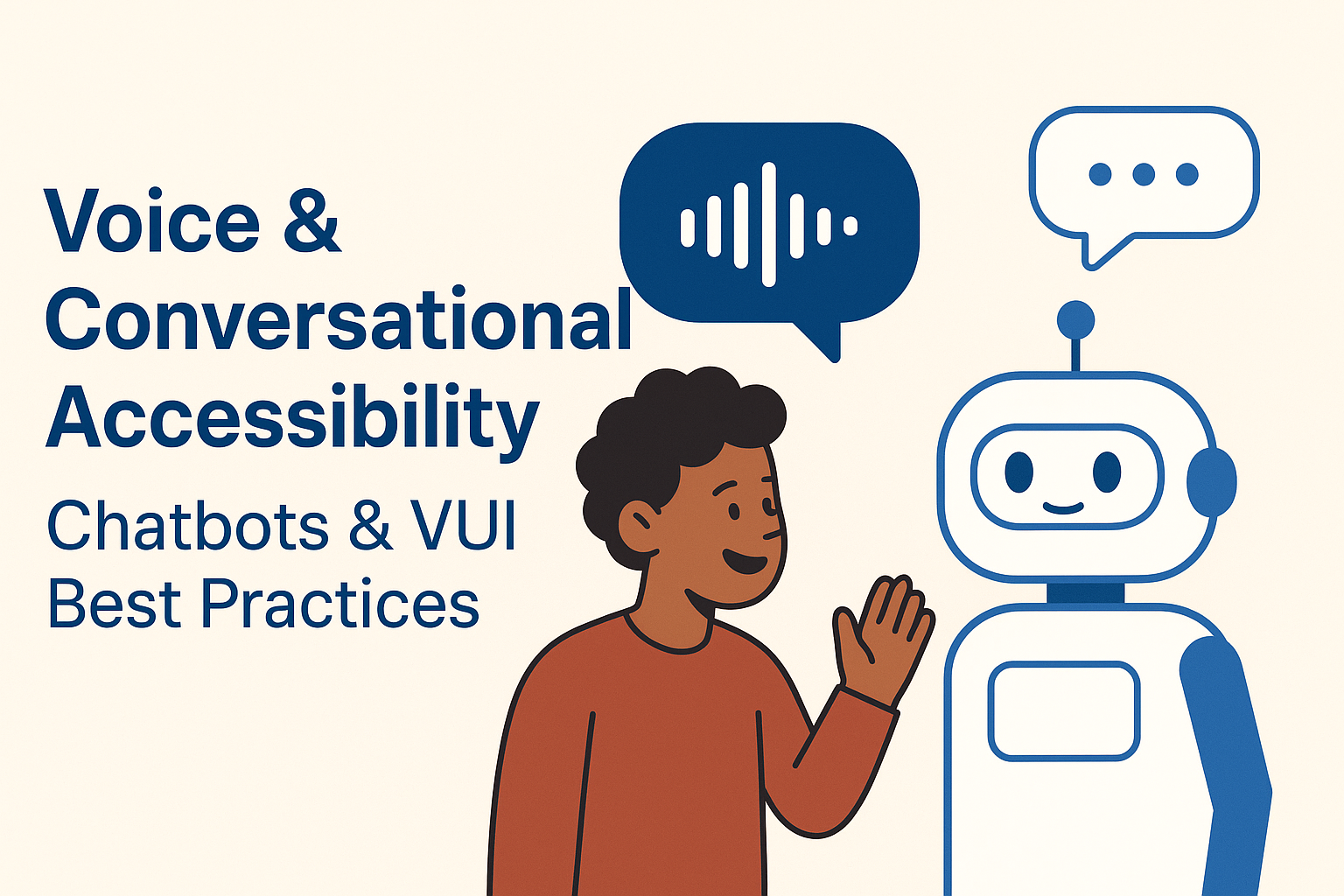
voice & Conversational Accessibility — Chatbots & VUI Best Practices
Voice & Conversational Accessibility — Chatbots & VUI
Introduction
Conversational interfaces — including chatbots, voice assistants, and voice user interfaces (VUIs) — have become core components of modern digital experiences. For users with disabilities, accessible voice and chatbot design can dramatically improve inclusion and usability. When built properly, these tools enable hands‑free interaction, natural communication, and equal access to information and services.
However, poorly implemented conversational systems can frustrate or exclude users with speech, cognitive, or hearing disabilities. This guide explores how to make chatbots and voice interfaces inclusive, compliant, and user‑friendly under WCAG 2.2 and W3C Voice Interaction Framework recommendations.
Why Conversational Accessibility Matters
- Users with mobility limitations rely on voice input or speech recognition instead of keyboards or touchscreens.
- People with vision impairments use voice interfaces and screen readers to access content.
- Individuals with cognitive or learning differences benefit from conversational systems that simplify complex tasks.
- Accessibility intersects with emerging technologies — inclusive design ensures equitable participation in new digital ecosystems.
Chatbot Accessibility Principles
1. Support Keyboard & Screen Reader Compatibility
Chat interfaces must be accessible without relying solely on mouse or touch. Users should be able to navigate chat widgets using Tab, Enter, and arrow keys. Screen readers must correctly announce new messages as they appear using aria-live="polite" for updates.
<div role="log" aria-live="polite" aria-relevant="additions">
  <div>Bot: Hello! How can I help you today?</div>
</div>
2. Provide Text Alternatives for Multimedia
If chatbots use audio, video, or visual cards, ensure captions, transcripts, or alt text are available. For visual avatars or GIFs, mark them as decorative or add contextual cues for screen readers.
3. Allow User Input Flexibility
Offer multiple input methods — typing, voice, button selections — to accommodate various users. Avoid designs that demand speech input only, which can exclude users with speech impairments or noisy environments.
4. Clear Focus Management
Ensure focus remains consistent during message updates and automatically scroll new replies into view without trapping keyboard users. After sending input, return focus logically (e.g., to the text field).
5. Cognitive Accessibility
Use simple language, short sentences, and confirm critical actions (“Would you like to confirm your payment now?”) before performing irreversible operations. Allow users to repeat information or request summaries.
Voice User Interface (VUI) Accessibility
1. Speech Recognition Accuracy & Alternatives
Provide fallback methods when speech recognition fails — such as on‑screen text or rephrased prompts. Avoid penalizing users for accents, stutters, or speech impediments.
2. Auditory Feedback & Clarity
Ensure spoken responses are concise, well‑paced, and easy to understand. Support playback speed adjustment and provide textual transcripts or captions for hearing‑impaired users.
3. Visual Reinforcement
For multimodal voice systems (smart displays, kiosks), pair speech output with visual text reinforcement. Maintain sufficient contrast and readable typography.
4. Respect Privacy & Consent
Voice interfaces often handle personal data. Use transparent notices about data usage and obtain explicit consent for microphone access. Allow users to delete recorded interactions easily.
Testing Conversational Accessibility
- Test chatbots using only keyboard navigation and screen readers (NVDA, JAWS, VoiceOver).
- Verify message announcements occur in correct order with
aria-live="polite". - Test voice apps with real speech variations — accents, languages, background noise.
- Include users with disabilities in usability testing to identify real‑world pain points.
Designing Inclusive Conversations
- Use polite, respectful, and inclusive responses — avoid gendered pronouns or assumptions.
- Provide explicit help commands (“Say ‘help’ for more options”).
- Support clear error recovery — offer retries instead of abrupt session ends.
- Anticipate varied user intent and normalize deviations in input syntax.
- Use affirmative cues (“Got it!” or confirmation tones) that work both visually and audibly.
WCAG Alignment for Conversational Systems
Conversational interfaces align with key WCAG success criteria:
- 1.2.1 Text Alternatives — Provide captions or transcripts for voice content.
- 2.1.1 Keyboard Accessibility — Ensure full operability without touch or mouse.
- 3.3.2 Labels or Instructions — Give clear input expectations and examples.
- 3.3.4 Error Prevention — Confirm high‑impact actions like payments or personal data submissions.
- 4.1.3 Status Messages — Announce chat updates programmatically for assistive technologies.
Common Mistakes
- No keyboard access to chatbot controls.
- Speech‑only systems with no text alternative.
- Rapid or unclear speech pacing lacking pause control.
- Unlabeled buttons or message bubbles.
- Overly complex chat language without context cues.
Best Practices Summary
- Design multimodal chat and voice interactions — support text, voice, and assistive input.
- Use semantic HTML and ARIA markup for message regions and interactive elements.
- Provide meaningful fallbacks when speech, network, or scripting fails.
- Ensure accessible privacy policies and clear consent for recordings.
- Include continuous user testing with people who rely on assistive technologies.
Benefits of Accessible Voice & Chat Systems
- Expands reach to broader user groups, including users with disabilities or temporary limitations.
- Builds trust through transparency and usability.
- Improves overall conversational quality and user satisfaction.
- Helps future‑proof voice and chat products as accessibility laws evolve.
Conclusion
Accessible conversational interfaces combine technology and empathy. By designing chatbot and voice experiences that respect user choice, provide text alternatives, and maintain multimodal access, teams foster communication equity and universal usability.
Next steps: Audit your chatbot or voice app for keyboard, speech, and text accessibility. Collaborate with users with disabilities to validate conversational flows and improve clarity, inclusion, and trust.