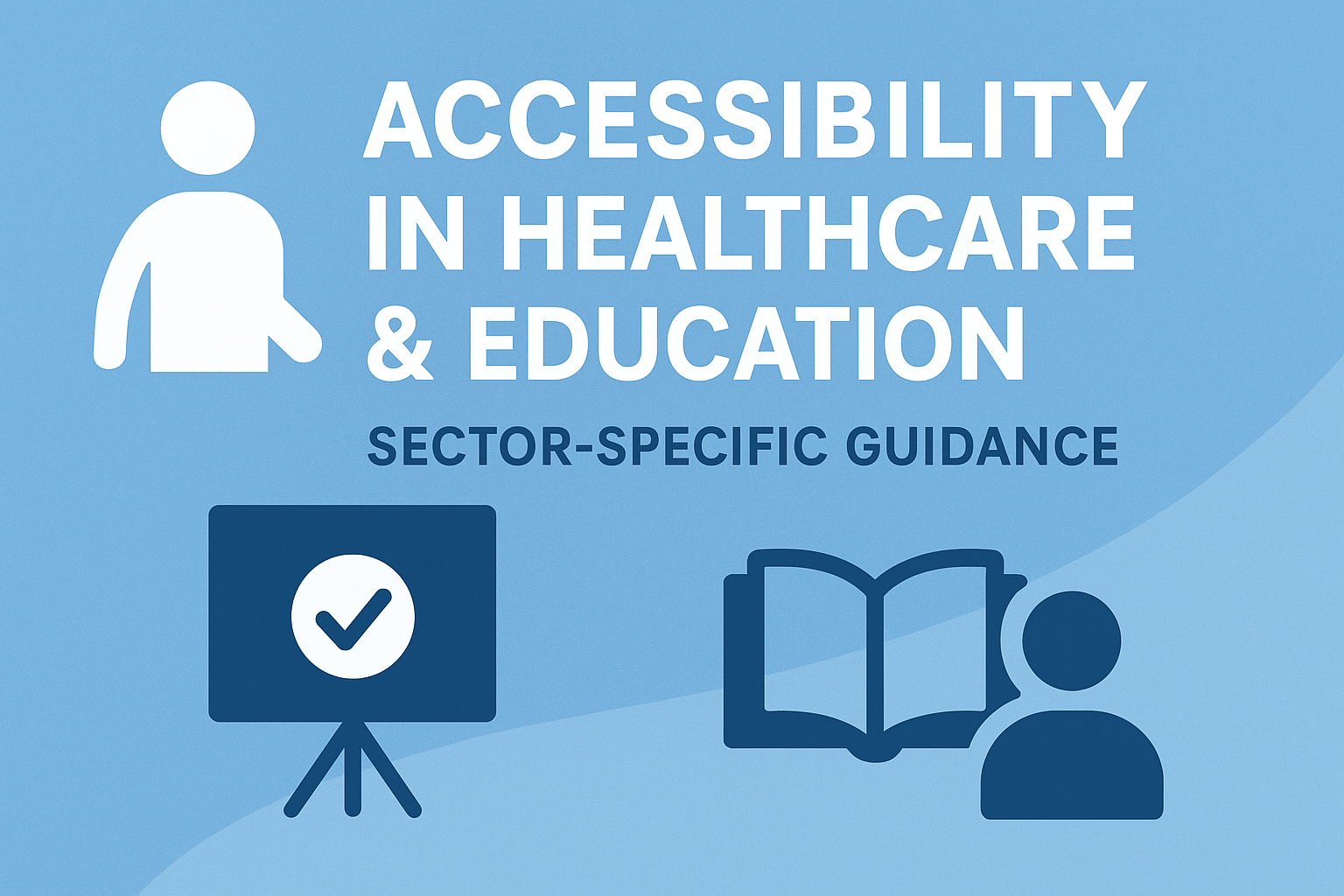
Accessibility in Healthcare & Education — Sector-Specific Guidance
Accessibility in Healthcare & Education
Introduction
Healthcare and education are two of the most essential services where digital accessibility has a profound impact. Accessible systems allow patients to manage care independently and empower learners of all abilities to succeed academically. Because both industries deal with sensitive data and critical interactions, accessibility is not just ethical—it’s legally required.
This section examines accessibility priorities, regulations, and implementation challenges specific to healthcare and education, providing actionable steps to achieve inclusion in both sectors.
Accessibility in Healthcare
1. Why Healthcare Accessibility Matters
Healthcare websites and applications often include patient portals, appointment booking tools, digital records (EHR/EPR systems), and telehealth platforms. Barriers in these tools can prevent people with disabilities from accessing essential services like scheduling visits or reviewing medical results.
Accessible healthcare technology supports independence, improves outcomes, and minimizes compliance risks under laws such as the Americans with Disabilities Act (ADA), Section 504, and Section 508.
2. Key Accessibility Considerations
- Patient Portals: Ensure forms, charts, and upload tools can be navigated with screen readers and keyboards.
- Telehealth Tools: Include live captioning, sign‑language video options, and keyboard operability for conferencing interfaces.
- Color & Typography: Use high contrast and readable fonts in dashboards for medical results or prescriptions.
- Accessible Reports & PDFs: Ensure discharge summaries and lab reports are fully tagged and searchable.
- Emergency Communication: Provide text‑based alternatives for alerts and forms during telemedicine sessions.
3. Applicable Legal Standards
- Section 508 of the Rehabilitation Act (U.S.): Requires accessible electronic and information technology for federally funded healthcare systems.
- WCAG 2.2 AA: The main technical accessibility benchmark referenced internationally.
- HIPAA Compliance Intersection: Accessibility should complement data privacy by ensuring secure, equal access to information.
4. Real‑World Best Practices
- Implement accessibility gates in all EHR updates and patient portal releases.
- Train frontline staff on using accessible digital communication formats.
- Offer accessible appointment reminders via SMS, email, and voice interfaces.
- Provide patient education materials in multiple accessible formats (HTML, tagged PDF, audio).
Accessibility in Education
1. The Importance of Access to Learning
Education accessibility ensures that students, parents, educators, and administrators can fully engage in digital learning systems. With widespread adoption of online learning platforms, inaccessible interfaces can create severe disadvantages for students with disabilities.
Accessible educational tools foster inclusion, increase engagement, and meet compliance obligations under laws like Section 504 and 508 (U.S.), the Individuals with Disabilities Education Act (IDEA), and the Equality Act (UK).
2. Key Accessibility Areas for Educational Platforms
- Learning Management Systems (LMS): Ensure all functions—including grades, assignments, and discussion boards—are fully keyboard and screen reader accessible.
- Video Lectures: Provide accurate captions, transcripts, and audio descriptions for course materials.
- Documents & Handouts: Distribute notes as tagged PDFs, readable HTML files, or accessible Word documents.
- Testing & Assessments: Ensure online forms and timed quizzes support assistive tools and extra‑time accommodations.
- Collaborative Tools: Platforms like Google Docs or Microsoft Teams must allow navigation by screen readers and support accessibility APIs.
3. Accessibility Policies & Procurement
Educational institutions should include accessibility audits as part of procurement policies for learning technology vendors. Request Voluntary Product Accessibility Templates (VPATs) to evaluate conformance and ensure accessibility compliance before purchase or deployment.
4. Teacher & Student Training
Training is critical for educators and support staff to understand how to deliver accessible content, such as captioning videos or writing simple and clear instructions. Students should also know how to use assistive technologies effectively to interact with educational software.
Shared Challenges Across Both Sectors
- Legacy software or files built before accessibility standards maturation.
- Complex workflows with specialized data visualizations and forms (e.g., EHR graphs, student transcripts).
- Integrating third‑party systems that lack WCAG conformance.
- Limited budgets or awareness of accessibility ROI among leadership.
- Balancing security, privacy, and accessibility simultaneously (e.g., authentication flows).
Best Practices to Embed Accessibility
- Adopt accessibility policies aligned with organizational mission and compliance law.
- Include accessibility checkpoints in product roadmaps and procurement contracts.
- Perform annual accessibility audits with both automated and manual review.
- Engage real users with disabilities during usability testing.
- Provide continuous staff training and certification opportunities.
Benefits of Inclusive Design for Healthcare & Education
- Improved Outcomes: Patients receive clearer instructions; students retain information better through accessible formats.
- Regulatory Compliance: Reduces risk of costly litigation or funding ineligibility.
- Operational Efficiency: Unified tools reduce support complaints and manual intervention.
- Equitable Experience: Builds trust, engagement, and inclusion at scale.
Conclusion
Accessibility in healthcare and education is a cornerstone of equity. By ensuring digital systems—from patient portals to virtual classrooms—are designed inclusively, organizations honor both ethical duty and legal responsibility. Proactive accessibility initiatives lead to better outcomes, less risk, and more empowered communities.
Next steps: Conduct an accessibility audit of your healthcare or educational platform, educate stakeholders on core compliance standards, and implement accessibility checkpoints within all procurement and design processes.