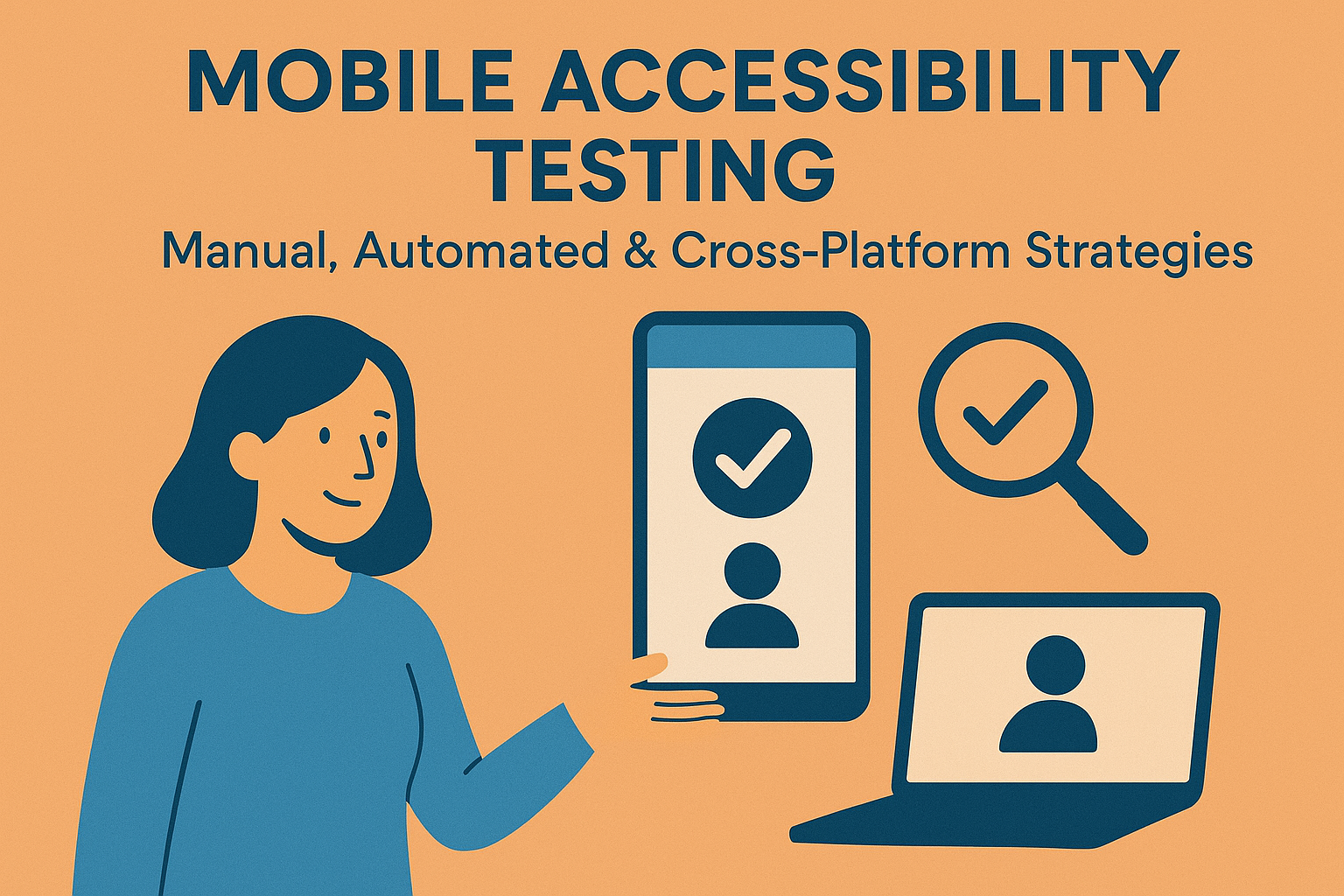
Mobile Accessibility Testing — Manual, Automated & Cross‑Platform Strategie
Mobile Accessibility Testing — Manual, Automated & Cross‑Platform Strategies
Introduction
As mobile devices have become the primary means of accessing digital content globally, mobile accessibility is non‑negotiable. Yet, many apps still neglect inclusive design and testing, excluding people who rely on screen readers, voice control, or switch devices. Testing for accessibility ensures your mobile app complies with WCAG 2.2 and platform‑specific mobile guidelines for Apple (iOS Human Interface Guidelines) and Google (Material Design Accessibility). This article explores how to perform manual, automated, and cross‑platform mobile accessibility testing for truly inclusive apps.
Why Mobile Accessibility Testing Matters
- More than half of global web traffic comes from mobile — inaccessible apps can exclude billions of potential users.
- Accessibility supports smoother user flows for everyone while ensuring legal compliance (ADA, EN 301 549, Section 508).
- Apple and Google require accessibility review for store approvals, increasing the cost of retroactive fixes.
Mobile Accessibility Standards
- WCAG 2.2: Provides cross‑platform accessibility criteria for mobile web and native apps.
- Mobile Accessibility Extension (WCAG WG): Adapts standards for touch, gesture, and context changes.
- iOS Accessibility API (UIAccessibility): Ensures VoiceOver and switch control compatibility.
- Android Accessibility API (Accessibility Node Info): Supports TalkBack, BrailleBack, and voice navigation features.
Manual Testing Methodology
1. Screen Reader Testing
- iOS: Enable VoiceOver (Settings → Accessibility → VoiceOver).
- Android: Enable TalkBack (Settings → Accessibility → TalkBack).
- Test that labels, buttons, and images announce clear roles and names (e.g., “Add to cart button”).
- Check logical focus order — no unexpected jumping or invisible components in reading sequence.
2. Color & Contrast Testing
- Use tools like WebAIM Contrast Checker or Color Contrast Analyzer to ensure 4.5:1 ratio for text and background.
- Verify that important information is not conveyed by color alone (WCAG 1.4.1 Use of Color).
3. Gesture & Touch Target Testing
- Tap targets should be at least 44 × 44 px with sufficient spacing (WCAG 2.5.5 Target Size).
- Ensure all gestures have a keyboard or button alternative for users with motor disabilities.
- Test voice navigation and switch control command accuracy on both iOS and Android.
4. Dynamic Content & Notifications
- Confirm that announcements for live updates use appropriate methods (
UIAccessibilityPostNotificationorAccessibilityEvent.TYPE_ANNOUNCEMENT). - Check that modals and toasts are focus‑manageable and dismissible.
Automated Accessibility Testing
Automation speeds up detection of common violations and ensures regression coverage across builds.
1. Android Tools
- Accessibility Scanner (Google): Analyzes current app screens for contrast, touch target size, and label issues.
- axe for Android: Integrates into Espresso tests to run WCAG checks automatically.
- Firebase Test Lab: Executes instrumented accessibility tests across multiple devices and screen sizes.
2. iOS Tools
- Xcode Accessibility Inspector: Checks labels, traits, and hit areas for UIKit elements.
- axe for iOS: CLI tool to analyze Swift & UIKit components using Deque axe engine.
- Swift Lint Accessibility Rules: Custom linters for alt attributes and focus handling errors.
3. Cross‑Platform Automation
- Integrate accessible unit tests in CI pipelines with axe CLI and Pa11y mobile scans.
- Use Appium with axe rulesets to run cross‑device accessibility tests automatically.
- Collect reports in Lighthouse CI dashboards for continuous visibility.
# Example Appium + axe automation snippet
const AxeBuilder = require('@axe-core/webdriverio').default;
await new AxeBuilder({ client })
  .analyze()
  .then(results => console.log(results.violations));
Cross‑Platform Testing Strategy
Accessibility testing should be comprehensive, covering both platform ecosystems while respecting their unique interaction models.
- Maintain separate iOS and Android test plans covering UI framework differences (SwiftUI vs. Jetpack Compose).
- Use design system tokens to enforce consistent contrast, font scaling, and hit area guidelines across apps.
- Establish a shared accessibility test suite and QA workflow to reuse cases across platforms.
Assistive Technology Compatibility
- VoiceOver (iOS): Read labels, landmarks, and custom UI components.
- TalkBack (Android): Read content descriptions from the Accessibility Node tree.
- Voice Control / Switch Access: Ensure command naming is logical (“Tap Add to Cart”) and visible elements are focusable.
Common Accessibility Gaps
- Unlabeled controls: Buttons or icons missing text equivalents.
- Dynamic content not announced: ARIA‑like events absent on updates.
- Low contrast text or small touch targets: Fail basic perception guidelines.
- Gesture‑dependent navigation: Ignoring users who can’t perform complex gestures.
Best Practices for Mobile Accessibility QA
- Include mobile accessibility criteria in QA checklists and release gates.
- Run integrated automated tests on every build push.
- Conduct manual accessibility reviews on key flows (login, checkout, search).
- Use real devices for testing — simulators don’t replicate assistive technologies accurately.
- Train QA and developers to use VoiceOver and TalkBack as part of their workflow.
Conclusion
Accessible mobile apps combine quality and credibility, enhancing both user experience and brand value. Continuous testing — manual and automated — keeps accessibility a living requirement throughout development. By integrating cross‑platform accessibility into every stage of the mobile SDLC, teams can deliver inclusive digital products that empower users worldwide.
Next Steps: Set up mobile accessibility testing across your QA pipeline, combine tool‑based detection with real assistive tech testing, and report metrics regularly to build a culture of inclusive mobile engineering.