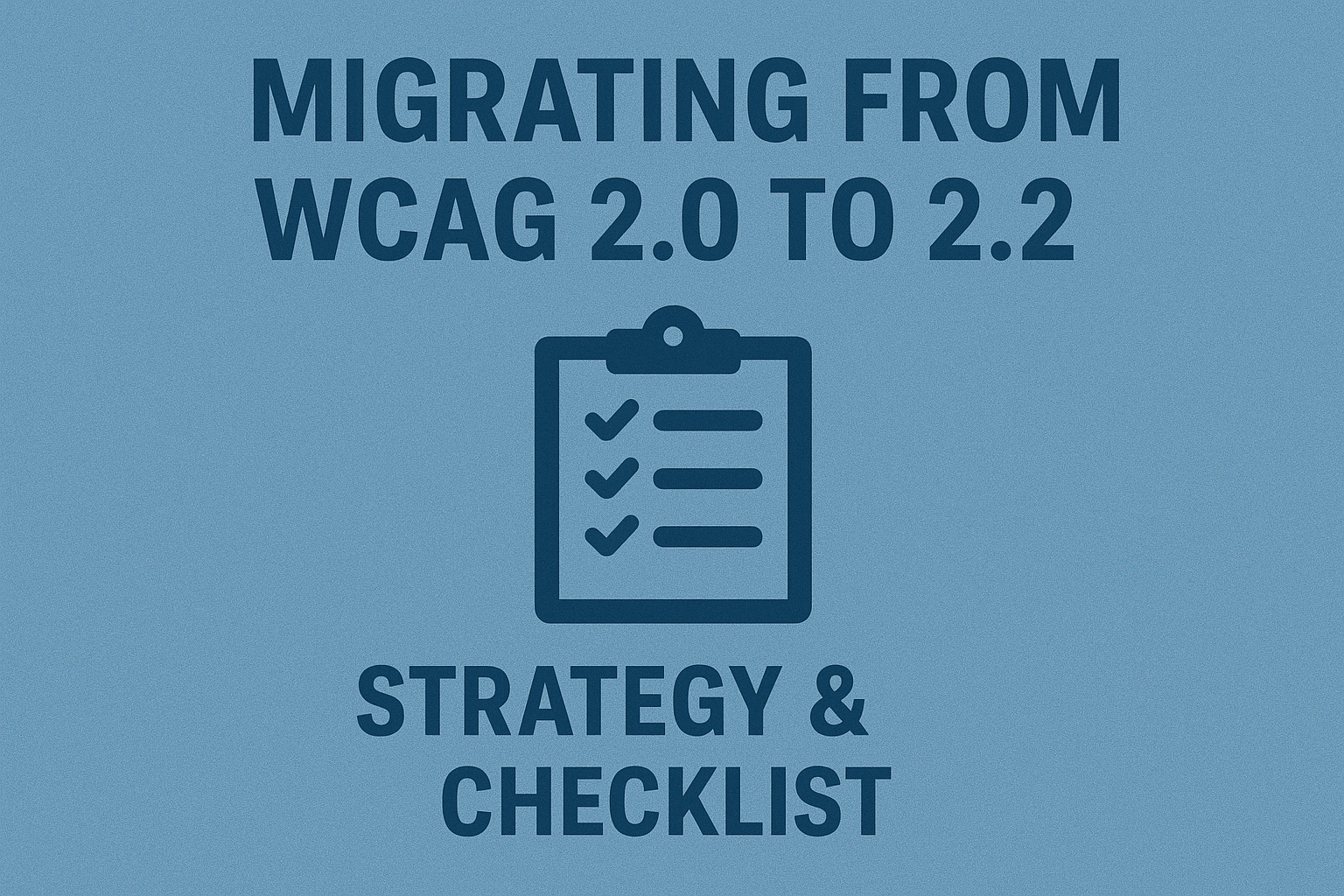
Migrating from WCAG 2.0 to 2.2 — Strategy & Checklist
Migrating from WCAG 2.0 to 2.2 — Strategy & Checklist
Introduction
WCAG has evolved steadily to keep pace with changes in technology and user needs. Moving from WCAG 2.0 (2008) through WCAG 2.1 (2018) and now WCAG 2.2 (2023) means organizations must keep accessibility requirements current. While the core structure — principles, guidelines, and success criteria — remains the same, new criteria and clarifications make a noticeable difference for users with low vision, cognitive disabilities, and mobile access needs.
This guide outlines a seamless strategy for upgrading your digital products to full WCAG 2.2 conformance, detailing what’s changed, what stays the same, and practical steps to future‑proof your accessibility program.
Why Update to WCAG 2.2
Continuing to use WCAG 2.0 may expose your website to legal risk and technical debt. WCAG 2.2 expands accessibility coverage while maintaining backward compatibility. Upgrading ensures:
- Alignment with the latest W3C recommendation.
- Improved experiences for mobile users and those with cognitive or fine‑motor challenges.
- New measurable guidance for focus visibility, drag gestures, and authentication.
- Compatibility with forthcoming WCAG 3.0 and international standards like EN 301 549 v3.2.1.
What’s New from 2.0 → 2.1 → 2.2
WCAG versions build cumulatively — WCAG 2.2 includes all criteria from 2.0 and 2.1 plus nine new success criteria and removes one obsolete requirement (4.1.1 Parsing).
Key Additions Since WCAG 2.1
- Focus Appearance (2.4.11): Quantitative contrast requirements for visible focus states.
- Focus Not Obscured (2.4.12–2.4.13): Focused items must remain visible and uncovered by pop‑ups or sticky headers.
- Dragging Movements (2.5.7): Functions requiring dragging must offer simple click‑alternatives.
- Target Size (Minimum) (2.5.8): Minimum 24×24 CSS pixels for interactive elements.
- Consistent Help (3.2.6): Links to support resources must remain in the same place across pages.
- Redundant Entry (3.3.7): Users should not re‑enter identical information within a session.
- Accessible Authentication (3.3.8): Sign‑in cannot depend on cognitive tests like CAPTCHAs without alternatives.
Criterion Removed
4.1.1 Parsing was retired because modern browsers and assistive tools handle minor HTML syntax errors without affecting accessibility.
Step‑by‑Step Migration Strategy
- Inventory Existing Conformance: Begin with your current WCAG 2.0 or 2.1 audit reports. Identify pages and components still using legacy markup patterns or CSS layouts incompatible with mobile zoom.
- Understand New Success Criteria: Map the nine new requirements to your templates (focus, drag controls, auth flows, etc.).
- Prioritize Impact: Tackle criteria that affect most users first — focus visibility and target size usually yield the greatest benefit.
- Update Design Systems: Embed new WCAG tokens into color, spacing, and interaction guidelines so future releases inherit compliance by default.
- Train Teams: Hold training sessions about WCAG 2.2’s differences for developers, designers, QA and content authors.
- Re‑Audit and Validate: After implementation, run both automated and manual tests. Document conformance by criteria and severity.
Mapping Old to New Criteria
Use the following cross‑reference to align existing WCAG 2.0/2.1 efforts with WCAG 2.2 expectations:
| WCAG 2.0/2.1 Criterion | WCAG 2.2 Equivalent / Update |
|---|---|
| 2.4.7 Focus Visible | Expanded under 2.4.11 Focus Appearance with defined contrast metrics |
| 2.5.5 Target Size (Enhanced – AAA) | Becomes 2.5.8 Target Size (Minimum – AA) |
| 2.1.1 Keyboard and 2.1.2 No Keyboard Trap | Unchanged but pair with Focus Not Obscured checks |
| 3.3.3 Error Suggestion | Extended by 3.3.7 Redundant Entry and 3.3.8 Accessible Authentication |
Migration Checklist
- ✅ All interactive controls tested for visible focus appearance (2.4.11)
- ✅ Ensure focus not blocked by fixed headers or overlays (2.4.12/13)
- ✅ Replace drag‑only interactions with click alternatives (2.5.7)
- ✅ Increase touch target size to minimum 24×24 px (2.5.8)
- ✅ Standardize help links across pages (3.2.6)
- ✅ Auto‑populate repeated form fields (3.3.7)
- ✅ Simplify login flows to avoid memory‑based tests (3.3.8)
- ✅ Update audit templates and scorecards to reflect new criteria numbers and ratings
Testing & Validation
Post‑migration, test for compliance at both code and experience levels. Combine automated scans with manual usability checks.
- Run automated WAVE, axe, and Lighthouse tests to catch regressions.
- Verify keyboard and touch navigation for focus visibility and target sizing.
- Use real assistive technologies (Screen Readers, Voice Control, Switch Devices) to validate operability.
- Cross‑test templates on desktop and mobile to confirm responsive behavior meets Reflow requirements.
Documentation and Reporting
Keep an audit trail of your upgrade journey. A clear record demonstrates due diligence and supports legal defensibility under accessibility laws.
- Include before/after screenshots of updated components.
- List resolved and outstanding issues mapped to WCAG 2.2 criteria.
- Maintain versioned reports (2.0 → 2.1 → 2.2) for future reference and audits.
Training & Governance
Migrating standards is as much about people as process. Ensure that design, development, and QA teams understand the changes and adapt workflows accordingly.
- Integrate WCAG 2.2 criteria into definition of done for all tickets.
- Add new checklist items for focus contrast and input redundancy to code reviews.
- Automate criteria tests in CI/CD pipelines for ongoing verification.
Future‑Proofing for WCAG 3.0
Upgrading now lays the groundwork for WCAG 3.0, currently in development as the W3C Accessibility Guidelines. WCAG 3.0 will use a more flexible scoring model while retaining the core principles of POUR. Sites meeting WCAG 2.2 AA today will transition more smoothly to future standards.
Conclusion
Migrating from WCAG 2.0 to 2.2 is less about rewriting content and more about adopting modern, inclusive patterns already proven in web accessibility. By following a structured migration plan — audit, map, update, test — you ensure your organization remains legally compliant and user‑friendly for everyone.
Next steps: Perform a gap analysis of your current site against WCAG 2.2, implement the new criteria in your design system, and schedule annual audits to maintain continuous conformance.