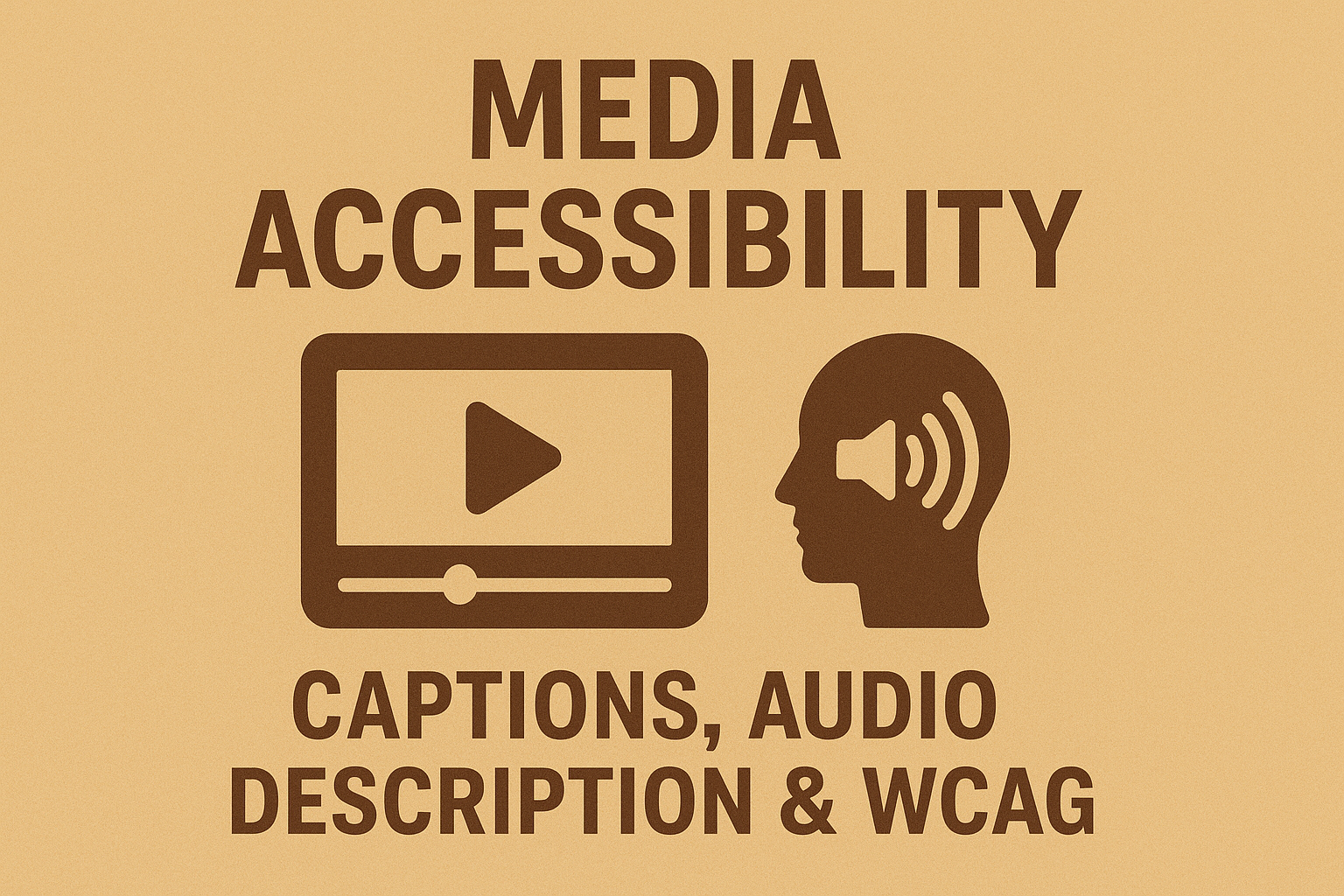
Media Accessibility — Captions, Audio Description & WCAG
Media Accessibility — Captions, Audio Description & WCAG
Introduction
Multimedia — videos, podcasts, livestreams, and presentations — is central to modern content delivery. Yet without text alternatives or audio descriptions, countless users are excluded. Media accessibility ensures that everyone, regardless of hearing or vision ability, can fully perceive the information being shared.
The Web Content Accessibility Guidelines (WCAG) provide clear requirements for making time‑based media inclusive. By following these standards — adding captions, transcripts, sign language, and descriptions — you meet the Perceivable principle of WCAG’s POUR framework and increase audience reach across platforms.
Why Media Accessibility Matters
Accessible media helps people with hearing loss, blindness, and temporary barriers such as noisy or silent environments. It also improves comprehension for non‑native language speakers and benefits anyone who learns better through reading or watching with text support.
- Captions support over 430 million people globally with disabling hearing loss.
- Audio descriptions make video content usable for blind or low‑vision audiences.
- Transcripts enable searching, quoting, and translating spoken content quickly.
Beyond inclusivity, accessible media improves SEO, watch time, and overall engagement.
WCAG Success Criteria for Time‑Based Media
1.2.1 Audio‑only and Video‑only (Pre‑recorded) (Level A)
Provide a text transcript for audio‑only content (like podcasts) and either a text or audio description for video‑only content with no sound. The goal is to ensure someone who cannot see or hear still receives the message.
1.2.2 Captions (Pre‑recorded) (Level A)
Synchronized captions must accompany all spoken dialogue and relevant sound effects in videos. Captions reflect speech, music, and background cues (honks, applause) within the same timeline.
1.2.3 Audio Description or Media Alternative (Pre‑recorded) (Level A)
For video with dialogue, provide audio description describing essential visual action — scene changes, text on screen, gestures — so blind users follow the plot. If not possible, add an alternative text or script.
1.2.4 Captions (Live) (Level AA)
Live webcasts and streamed events require real‑time captioning through automatic speech recognition or human captioners to serve audiences in real time.
1.2.5 Audio Description (Pre‑recorded) (Level AA)
Pre‑recorded videos with visual information beyond dialogue must include integrated audio description tracks or extended versions pausing between scenes to narrate details.
1.2.6 Sign Language (Level AAA)
Provide sign‑language interpretation for pre‑recorded audio content. Though AAA‑level, it is recommended for public information and educational media.
1.2.8 Media Alternative (Pre‑recorded) (Level AAA)
Supply a complete alternative text document with all spoken dialogue and described actions so the video’s full story is communicated via text alone.
Captions Best Practices
- Use .srt or .vtt files for consistent timing and cross‑platform support.
- Keep captions synchronized within one second of audio.
- Identify speakers when dialogue switches.
- Include important sound effects in brackets (e.g., [applause], [door slams]).
- Ensure caption font size and contrast (white or yellow on dark background) meet WCAG 1.4.3 contrast ratios.
Example HTML Video with Captions
<video controls>
  <source src="example.mp4" type="video/mp4">
  <track src="captions.vtt" kind="captions" srclang="en" label="English">
</video>
Audio Description Implementation
Audio description adds spoken narration between dialogue pauses to explain visual content. You can record a secondary audio track or include narration directly in editing. For complex videos,
provide an extended version with extra pauses for descriptions.
- Describe actions, expressions, and text shown on screen.
- Avoid subjective language — only state what can be seen visually.
- Sync description timing to natural breaks in dialogue for clarity.
When publishing, specify audio‑description tracks with appropriate labels for assistive technology.
<video controls>
  <source src="film.mp4" type="video/mp4">
  <track src="film-description.vtt" kind="descriptions" srclang="en" label="Audio Description">
</video>
Transcripts and Text Alternatives
Transcripts fulfill WCAG 1.2.1 and provide a universal alternative for audio and video alike. They allow users to read content offline, translate it, and use screen readers for navigation.
- Place transcripts directly beneath the media element or link to a separate HTML page.
- Include speaker names and timestamps to preserve structure.
- Ensure layout contrast and spacing for readability by low‑vision users.
Embedding Accessible Players
Some custom video players remove native caption support. Choose players or libraries that expose controls to assistive technologies and allow keyboard focus.
- Use HTML5 <video> and <audio> elements where possible.
- Ensure Pause/Play, Volume, and CC buttons are keyboard accessible.
- Provide visible focus rings for controls and ARIA labels for each button.
<button aria-label="Toggle Captions">CC</button>
<button aria-label="Play or Pause">▶</button>
Live Streaming and Event Accessibility
WCAG 2.2 (Level AA) requires captioning for live audio content. Organizations running webinars or events should plan ahead for real‑time captioning or sign‑language interpreters.
- Use human captioners or AI‑assisted tools with monitor review.
- Stream through platforms supporting CART and multi‑track audio.
- Offer viewers a separate caption window if platform limitations exist.
Testing Media Accessibility
Testing ensures captions, descriptions, and transcripts function correctly across browsers and devices. Follow these steps:
- Play videos with screen reader enabled and verify that track labels announce language and type (captions or descriptions).
- Check synchronization between audio and captions.
- Ensure controls are keyboard‑navigable and visible at all zoom levels.
- Use browser DevTools or Media Inspector to confirm
<track>elements load properly.
Common Problems & Fixes
- Missing Captions: Generate text tracks using speech‑to‑text tools and edit for accuracy.
- Auto‑generated captions inaccurate: Always proof and correct the file before publishing.
- Unlabeled tracks: Add clear language codes (srclang="en") and labels.
- Custom player lacks focus: Rebuild controls with button roles and tabindex support.
- Transcripts hidden in images or PDFs: Provide structured HTML text instead.
Inclusive Design Beyond Compliance
Accessibility is not a checkbox but a communication principle. Prioritize media that works in silent offices, noisy cafes, and low bandwidth conditions. Offer multi‑modal choices—watch, listen, or read—so users decide the best way to experience information.
- Provide downloadable transcripts for offline learning.
- Offer caption language options for global audiences.
- Test media on mobile to ensure captions scale and remain readable.
Conclusion
Ensuring audio and video accessibility creates equitable communication. By following WCAG’s media criteria — captions, transcripts, and audio descriptions — you deliver inclusive experiences that benefit all users. Accessible media enhances understanding, searchability, and user trust.
Next steps: Audit your media library for caption coverage, add audio descriptions to critical content, and test videos using screen readers and keyboard‑only controls. Consistent attention to media accessibility elevates compliance and user experience alike.