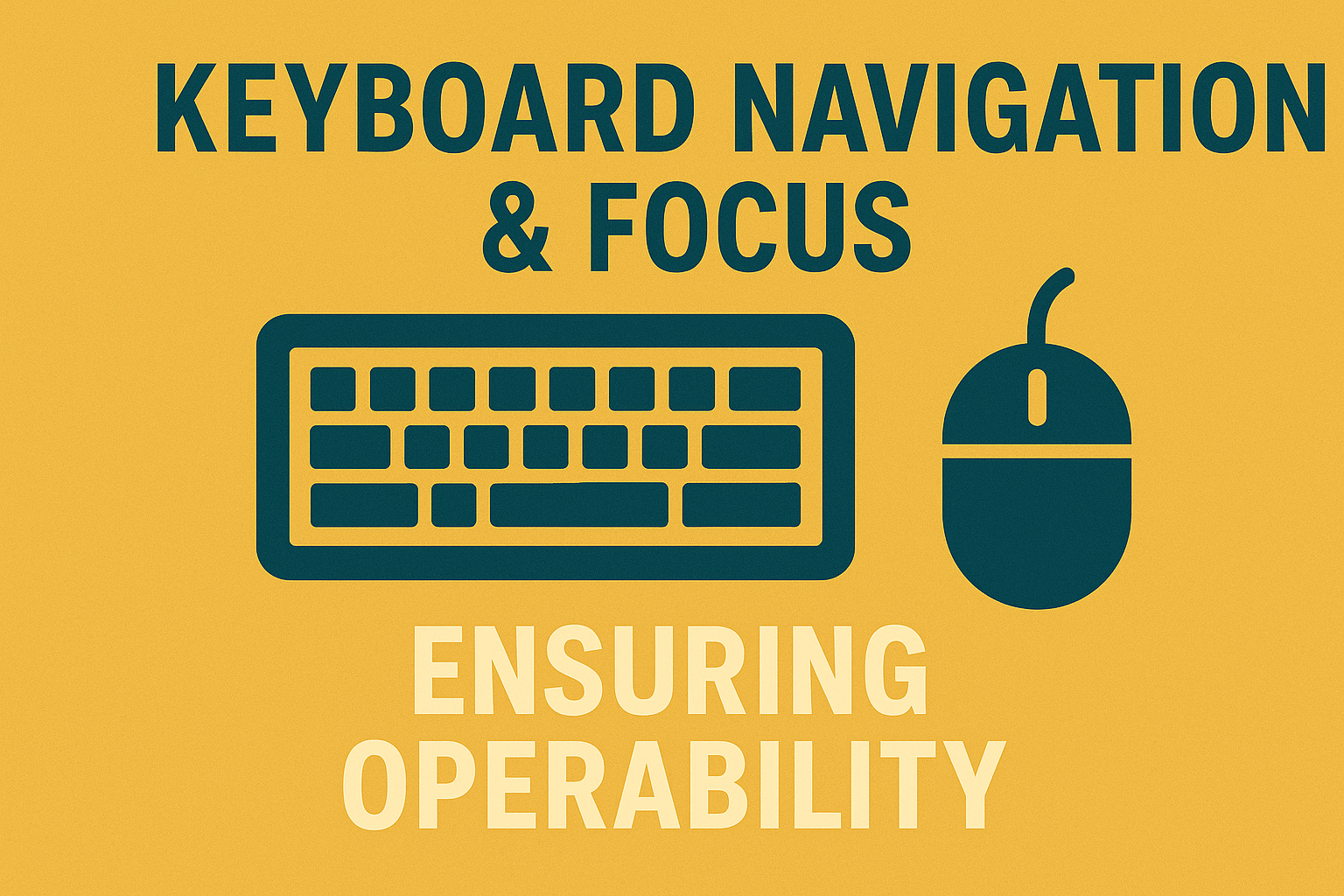
Keyboard Navigation & Focus — Ensuring Operability (WCAG)
Keyboard Navigation & Focus — Ensuring Operability (WCAG)
Introduction
Keyboard accessibility ensures that every interactive element on a website or application can be used without a mouse. This functionality is not only essential for users with motor impairments or low vision but also improves usability for everyone who prefers keyboard shortcuts and faster navigation. Proper focus management ensures orientation and predictability as users move through controls.
According to the Web Content Accessibility Guidelines (WCAG), user interfaces must be fully operable through keyboard input without requiring pointer devices. This ability aligns with the Operable pillar of the WCAG POUR framework (Perceivable, Operable, Understandable, and Robust).
Why Keyboard Accessibility Matters
Keyboard operability is a baseline accessibility need. For many, it’s the only way to navigate. Screen reader users, people with tremors, or temporary injuries all rely on functional keyboard input. Even advanced users benefit from the speed and ergonomics of key commands.
- Users with mobility limitations cannot rely on precise mouse control.
- Screen reader users interact by sequential keyboard navigation through headings, links, and form elements.
- Keyboard navigation improves accessibility for kiosk interfaces, TVs, and embedded browsers that lack pointing devices.
If your site cannot be used entirely via keyboard, it fails WCAG success criteria 2.1.1 Keyboard and 2.1.2 No Keyboard Trap — fundamentals of accessibility conformance.
Core WCAG Success Criteria for Keyboard Navigation
1. All interactive elements must be reachable by keyboard
Every function operable by mouse must have an equivalent keyboard method. Links, buttons, and inputs must appear in tab order using the natural HTML flow. Developers should avoid JavaScript event handlers dependent solely on onclick or pointer actions.
<button>Submit Form</button>

<!-- Custom element example with accessibility -->
<div role="button" tabindex="0" aria-pressed="false">Toggle Menu</div>
2. Visible focus indicator
A visible focus outline shows which element is active. Default browser outlines are acceptable and must not be removed without replacement. WCAG 2.4.7 Focus Visible (Level AA) specifies the need for a distinguishable focus indicator so users always know where they are.
:focus-visible {
  outline: 3px solid #fcb900;
  outline-offset: 3px;
}
3. Logical focus order
Focus should follow the reading and visual order — top‑to‑bottom, left‑to‑right for Western languages. Arbitrary tab index assignments make interfaces confusing. Ideally, keep the DOM order aligned with visual structure.
4. Avoid keyboard traps
Don’t confine focus within widgets or modals. Implement focus traps that activate only when components are open and release users once dismissed. Users must always move freely using Tab and Shift + Tab.
Focus Management Patterns
Proper focus management directs user attention to relevant areas and restores it when necessary.
- Initial Focus: When dialogs or overlays open, move focus to the heading or first input inside them so users know context immediately.
- Return Focus: When closing overlays, return focus back to the triggering element (for example, the button that opened the modal).
- Skip Links: Provide a visible “Skip to Main Content” link at the top of pages so keyboard users can bypass repetitive menus.
- Tab Management: Use
tabindex="0"to insert custom elements into tab order ortabindex="-1"for programmatic focus only.
These patterns maintain predictability and save key presses for users relying on sequential navigation.
Best Practices for Implementation
- Use semantic HTML controls (
<button>,<a>,<input>) that have native keyboard support. - Never hide focus outlines without adding an accessible alternative such as a colored border or shading.
- For custom widgets, assign ARIA roles and states (
aria-expanded,aria-pressed) to communicate functionality. - Ensure keyboard shortcuts do not conflict with assistive‑technology hotkeys or browser defaults.
- Programmatically manage focus on dynamic content using
element.focus()after route changes in single‑page apps.
Testing Keyboard Accessibility
Keyboard testing is straightforward but irreplaceable. To evaluate operability:
- Unplug the mouse or disable touchpad input.
- Navigate with Tab, Shift + Tab, Enter, Space, and Esc.
- Check that every interactive element can be reached and activated logically and without traps.
- Verify that focus never disappears off‑screen or jumps erratically.
Run automated analyzers such as WAVE, axe DevTools, or Lighthouse to find missing roles and contrast problems. Combine automation with hands‑on keyboard tests.
Common Issues & How to Fix Them
- Hidden but focusable elements: Apply
display:noneoraria-hidden="true"so screen readers and keyboard focus ignore them until visible. - Focus lost after updates: When loading new content via JavaScript, move focus to the main heading or region of the new section.
- No visible focus: Re‑enable default outlines or design custom focus cues with at least 3 : 1 contrast against the background.
- Keyboard trap in modals: Allow Tab navigation within the modal while open and release to the trigger once closed.
Enhancing Single‑Page Applications (SPAs)
Many SPA frameworks replace only portions of the page rather than reloading it. Without manual focus control, users can lose track of context when routes change.
// Example: set focus to new view
const main = document.querySelector('main');
main.focus();
Provide focusable landmarks for dynamic viewports. Announce route changes using ARIA live regions so screen readers describe updates aloud.
ARIA Roles that Support Keyboard Navigation
- role="button" / "link": Defines element purpose and activates with Enter or Space.
- role="dialog": Constrains keyboard focus during modal interaction.
- role="menu" / "menuitem": Enables arrow key navigation within menus.
- role="tabpanel" / "tablist": Communicates relationship between tab labels and panels.
Combine ARIA attributes with keyboard events (keydown, keyup) to mimic native behavior.
Keyboard Shortcuts and Hotkeys
When introducing keyboard shortcuts (AccessKey or custom combinations), choose keys that don’t conflict with screen readers or browser defaults. Offer a help menu listing available shortcuts and provide a disable option for users who do not want them.
Making Navigation Intuitive
- Maintain consistent order and spacing between links and buttons across pages.
- Label navigation landmarks with
<nav aria-label="Main navigation">for screen reader jump lists. - Minimize Tab stops by grouping related controls into logical regions.
Focus Styles for Visual Clarity
WCAG 2.2 adds quantitative requirements for focus appearance (2.4.11 Focus Appearance AA). Indicators must have at least 3 : 1 contrast with adjacent colors and cover a minimum area around the focus target. Use thicker borders, color inversion, or glow effects to make states prominent.
button:focus-visible {
  box-shadow: 0 0 0 3px #2aa9e0;
}
Browser and Framework Considerations
- React / Vue / Angular: Preserve native event handling and avoid custom indexes disrupting DOM order.
- Tailwind or CSS frameworks: Ensure utility classes retain focus outlines and don’t reset them globally.
- Third‑party modal components: Verify they handle focus trapping and release following WCAG 2.1.2.
Checklist for Developers
- ✅ Every interactive element is achievable with the keyboard
- ✅ Focus indicator clearly visible at all times (3 : 1 contrast minimum)
- ✅ Logical tab order that follows page reading sequence
- ✅ No keyboard trap present in dialogs or sliders
- ✅ Skip link enables bypassing repetitive menus
- ✅ Dynamic views restore focus to meaningful regions
Conclusion
Ensuring good keyboard operability is one of the simplest and most impactful steps toward digital accessibility. Logical focus order, visible indicators, and full key equivalence let everyone interact efficiently, from people using screen readers to expert coders navigating forms quickly.
Next steps: Perform a keyboard‑only audit, verify ARIA roles for custom widgets, and enforce tab consistency in your design system. Accessible keyboard support benefits every user and is a core WCAG requirement for an Operable interface.