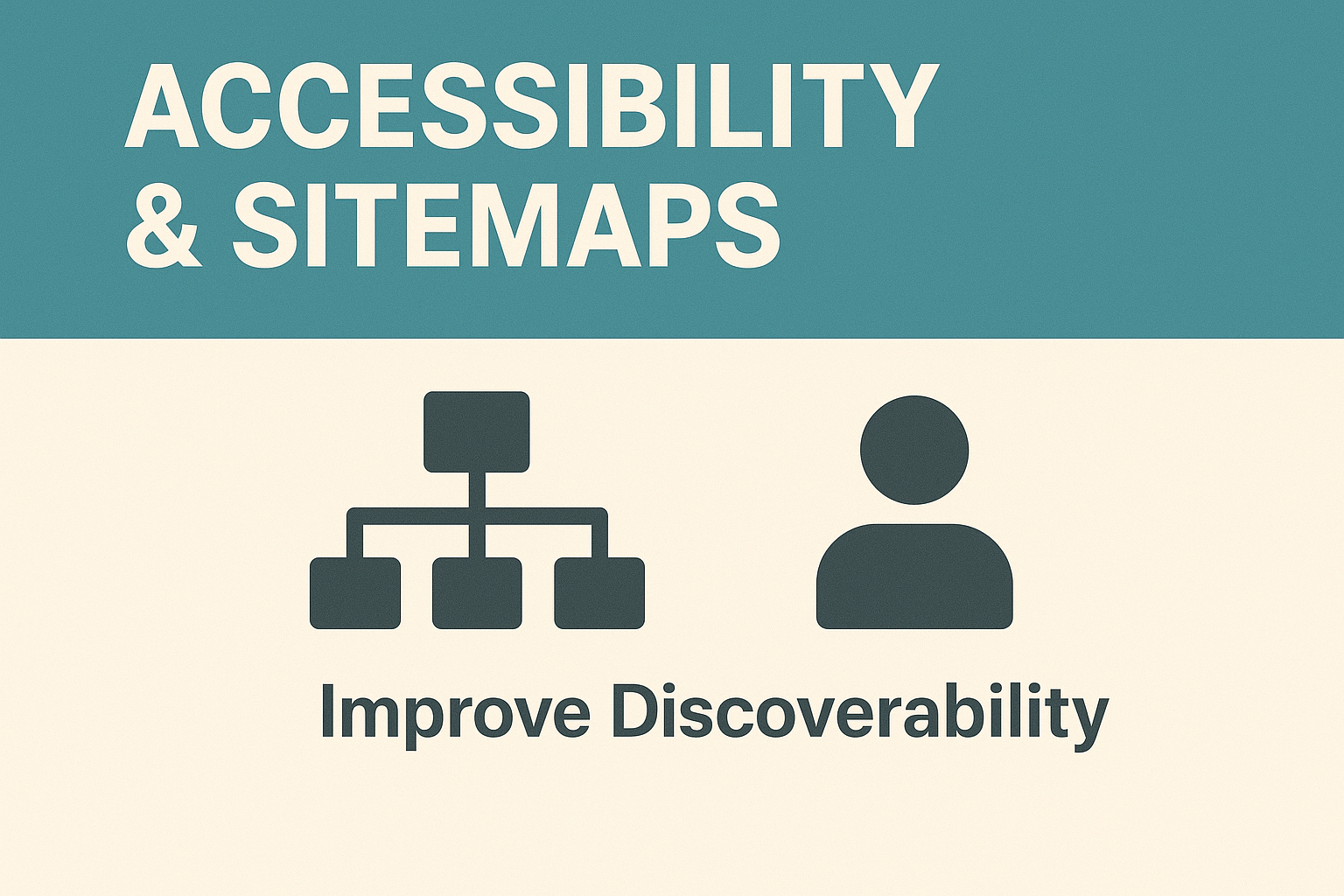
Accessible Navigation & Sitemaps — Improve Discoverability
Implementing Accessible Navigation & Sitemaps
Introduction
Navigation and sitemaps are the structural backbone of any digital experience. They guide users to information, features, and key interactions. For accessibility, navigation must be operable by keyboard, understandable by screen readers, and structured logically in the page layout. Accessible navigation helps everyone — including those using assistive technologies — discover content efficiently and confidently.
This guide outlines best practices for making primary navigation, secondary menus, and sitemaps compliant with WCAG 2.2 and assistive technology expectations.
Why Accessible Navigation Matters
- Screen reader users rely on headings, landmarks, and link structure to navigate quickly.
- Keyboard users require predictable focus order and clear skip links.
- Accessible sitemaps enhance understanding of site hierarchy.
- Compliance with WCAG 2.2 (2.1.1 Keyboard and 2.4.5 Multiple Ways) reduces barriers and boosts usability for all.
Core Principles of Accessible Navigation
- Consistency: Navigation menus appear and behave the same across all pages.
- Hierarchy: Organize links logically by importance and relationship.
- Operability: Full control via keyboard and assistive technology.
- Alternative Paths: Provide multiple ways (search, sitemap, footer menus) to reach each page.
Creating Accessible Site Navigation
1. Use Semantic Structure
Wrap navigation regions in semantic HTML for assistive technologies:
<nav aria-label="Main navigation">
  <ul>
    <li><a href="/about">About</a></li>
    <li><a href="/services">Services</a></li>
    <li><a href="/contact">Contact</a></li>
  </ul>
</nav>
The aria-label attribute helps screen readers distinguish multiple <nav> regions, e.g., “Main navigation” vs. “Footer navigation.”
2. Implement Skip Links
Provide a skip‑to‑content link at the top of each page so keyboard users can bypass repetitive navigation.
<a href="#main" class="skip-link">Skip to main content</a>
Ensure it is visible when focused, for example:
.skip-link {
  position: absolute; left: -999px;
}
.skip-link:focus {
  left: 0; top: 0; background: #000; color: #fff; padding: 8px;
}
3. Keyboard Navigation & Focus States
- Use Tab and Shift + Tab to move sequentially through menu items.
- Set visible focus indicators for all focusable items.
- Implement Enter or Space for activation and Esc for closing sub‑menus.
Always maintain logical tab order following the visual reading flow.
4. Multi‑Level Menus & ARIA Roles
For dropdown or mega menus, ARIA properties communicate relationships between menu items and sub‑menus.
<button aria-haspopup="true" aria-expanded="false" aria-controls="submenu">
  Services
</button>
<ul id="submenu" role="menu">
  <li role="none"><a role="menuitem" href="/consulting">Consulting</a></li>
  <li role="none"><a role="menuitem" href="/training">Training</a></li>
</ul>
Use ARIA roles like menu and menuitem with caution, and only when native semantics aren’t possible; otherwise, keep standard lists and links.
Accessible Sitemap Design
A sitemap provides an overview of site structure, giving screen reader and keyboard users clear pathways. Follow these practices for accessible sitemaps:
- Provide a dedicated page (linked in the footer) with a hierarchical, list‑based site outline.
- Use nested
<ul>lists reflecting category → subcategory structure. - Ensure every link is descriptive and accessible via keyboard.
- Use heading levels (
<h2>Sub‑section</h2>) to divide sitemap categories.
Example Sitemap Pattern:
<h2>Products</h2>
<ul>
  <li><a href="/product/a">Product A</a></li>
  <li><a href="/product/b">Product B</a></li>
</ul>
Alternative Navigation Options
- Search Functionality: Offer accessible search inputs with
<label>oraria-label. - Breadcrumb Trails: Provide context of the current page in hierarchy using ordered lists with
aria-label="Breadcrumb". - Footer Links: Repeat essential links in the footer for redundant access points.
Testing Navigation Accessibility
- Test with keyboard only—no mouse—to ensure full operability.
- Validate navigation hierarchy with screen readers (NVDA, VoiceOver).
- Check all skip links and focus states on various screen sizes.
- Run automated testing tools (axe, WAVE) for missing link text or landmark issues.
Common Mistakes
- Using visual icons without accessible link text.
- Hiding skip links without making them focus‑visible.
- Building menus dependent solely on hover for expansion.
- Duplicating identical link text for different targets (e.g., “Read more”).
Benefits of Accessible Navigation & Sitemaps
- Improves orientation for all users, including those unfamiliar with your site.
- Enhances SEO through clear linkage and structure.
- Reduces bounce rates and user frustration.
- Ensures compliance with WCAG’s operable and navigable content standards.
Conclusion
Accessible navigation and sitemaps are foundational to a seamless user experience. By combining semantic structure, keyboard operability, descriptive link text, and skip links, organizations create clear, inclusive journeys that empower all users to find what they need efficiently.
Next steps: Audit your site navigation structure, add accessible skip links and sitemaps, and test with screen readers and keyboard navigation to confirm complete discoverability and usability.