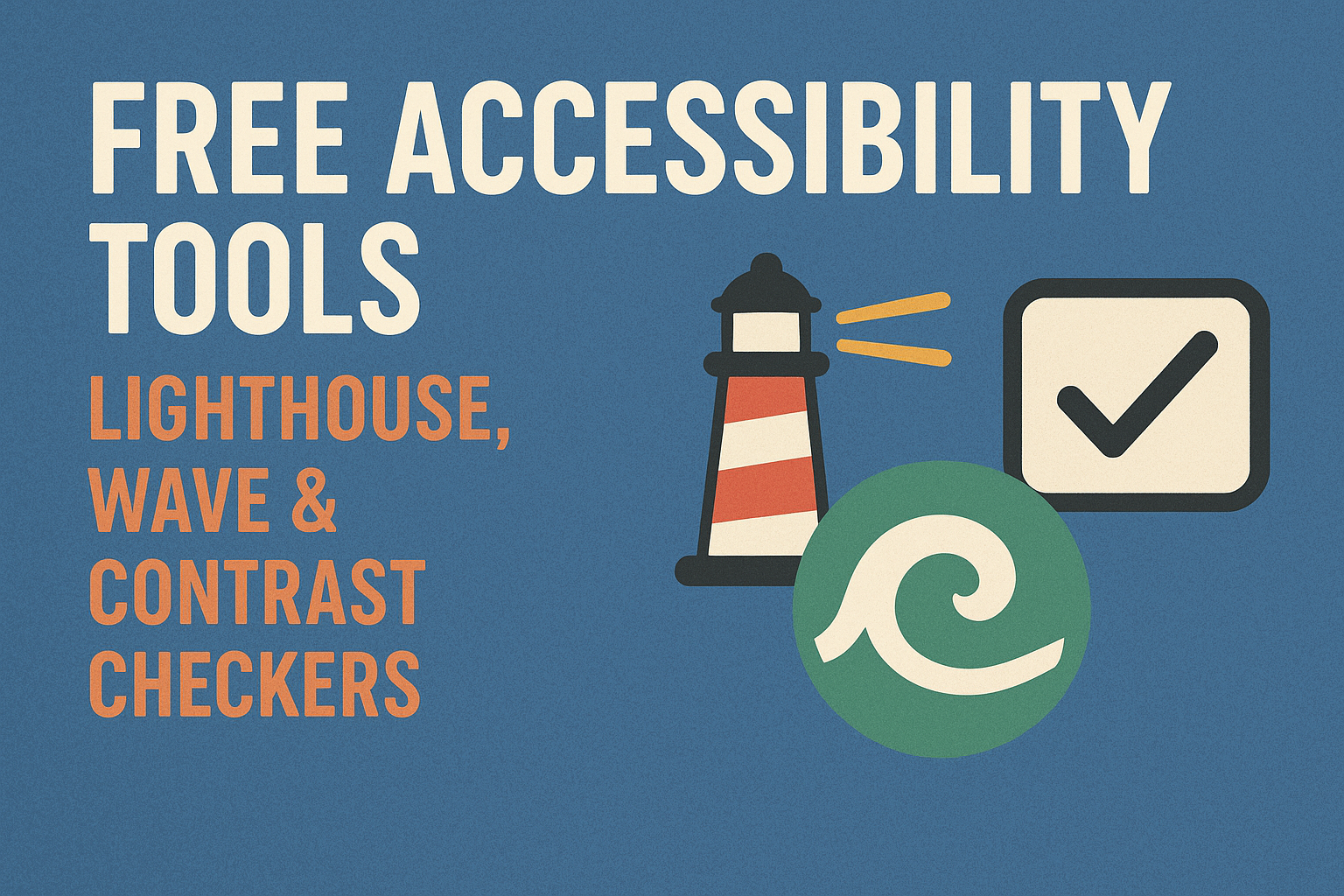
Free Accessibility Tools — Lighthouse, WAVE & Contrast Checkers
Free Accessibility Tools & How to Use Them
Introduction
Accessibility testing doesn’t have to be expensive. Many powerful tools are freely available to help designers, developers, and content creators identify accessibility issues during any stage of the project lifecycle. From browser extensions and color contrast analyzers to automated auditing frameworks, free accessibility tools enable teams to build inclusive digital products without large budgets.
This guide highlights the most effective free accessibility testing tools, explains when and how to use them, and shows how they fit into a broader accessibility workflow based on WCAG 2.2 AA principles.
1. Lighthouse (Chrome DevTools)
Lighthouse is built into Chrome DevTools and provides an automated audit of your web page, including accessibility metrics. It’s ideal for quick checks and early feedback during development.
How to Use Lighthouse:
- Open Chrome DevTools (Right‑click → Inspect → Lighthouse).
- Select the “Accessibility” audit category.
- Run the report for Desktop or Mobile mode.
- Review numerical score and detailed list of failing elements.
Key Features:
- Scores pages on accessibility performance.
- Identifies missing alt attributes, low contrast, and ARIA misuse.
- Integrates easily into CI/CD workflows via
lighthouse-ci.
2. WAVE (WebAIM Evaluation Tool)
The WAVE tool by WebAIM is one of the most trusted visual accessibility evaluation extensions for Chrome and Firefox. It overlays icons and summaries directly on top of the tested web page, showing where structural or visual issues occur.
How to Use WAVE:
- Install the WAVE browser extension.
- Browse to any web page and click the WAVE icon.
- Review flagged items like missing form labels, heading structure problems, or low color contrast.
- Use the “Details” tab to locate the element in source code.
Advantages:
- Immediate visual feedback directly over your site.
- Categorized issues (Errors, Alerts, Features, Structure, Contrast).
- No internet submission — all scanning runs locally for privacy.
3. axe DevTools (Community Edition)
Deque Systems’ axe DevTools is an advanced extension for Chrome and Firefox offering in‑depth automated accessibility testing based on the open‑source axe-core engine.
How to Use axe DevTools:
- Install the free community edition browser extension.
- Open DevTools → axe tab → “Analyze.”
- See categorized issues with WCAG references and fix guidance.
Key Benefits:
- Runs industry‑standard accessibility checks seamlessly in DevTools.
- Provides related WCAG criteria and remediation recommendations.
- Exports reports for tracking and documentation.
4. Color Contrast Analyzers
TPGi Color Contrast Analyzer (CCA)
A desktop tool used by designers to compare text and background color combinations.
Why It’s Useful:
- Performs contrast ratio calculations against WCAG 2.1 standards.
- Supports on‑screen color picking or hex input.
- Quickly validates contrast changes in mockups or live applications.
WebAIM Contrast Checker
The WebAIM Contrast Checker offers a simple web‑based interface to test and tweak colors instantly. It’s ideal during the design phase before coding.
5. Accessibility Insights
Created by Microsoft, Accessibility Insights includes tools for both developers and testers. It comes in two flavors: Desktop (for Windows apps) and Browser extension (for web pages).
- FastPass: Runs automated checks on a live web page.
- Assessment mode: Provides guided manual testing walkthroughs.
- Ad Hoc Tools: Includes color pickers and focus visualization.
6. Pa11y
Pa11y is a command‑line tool and Node.js library for automated accessibility testing, great for integrating into CI/CD pipelines.
Use Case:
npx pa11y https://example.comIt returns an easily parseable JSON report listing errors, warnings, and WCAG violations—allowing automation workflows to flag non‑compliant pages.
7. Screen Reader Testing Tools
While manual testing takes time, free screen reader software ensures real‑world validation:
- NVDA (Windows) — screen reader with robust testing features.
- VoiceOver (macOS/iOS) — built‑in screen reader for Apple devices.
Testing with these tools helps verify reading order, focus transitions, and alt content accuracy.
Integrating Free Tools Into a Workflow
Design Phase
- Use WebAIM Contrast Checker to validate accessible color palettes.
- Run CCA or Stark plugin inside Figma or Sketch for quick visual testing.
Development Phase
- Run axe DevTools or Lighthouse before merging code changes.
- Commit to detecting and fixing issues at component level, not post‑release.
Testing & QA Phase
- Integrate Pa11y CLI into CI pipelines for ongoing automated audits.
- Use Accessibility Insights for structured manual evaluations.
Best Practices
- Combine multiple tools—no single scanner detects every issue.
- Pair automated results with human validation and user testing.
- Document fixes and track progress in issue‑management systems.
- Educate teams on interpreting automated results correctly to avoid false positives.
Common Mistakes
- Relying exclusively on automated scores from Lighthouse.
- Ignoring manual testing and real user verification.
- Failing to retest after code or layout updates.
- Using contrast tools without checking actual on‑screen backgrounds.
Conclusion
Free accessibility tools democratize inclusive design by offering robust scanning, reporting, and learning capabilities without high costs. Using them systematically across design and development stages prevents regressions and fosters everyday accessibility accountability.
Next steps: Integrate at least one free tool (like axe DevTools or Lighthouse) into your workflow today. Combine automated checks with manual testing to ensure your digital products meet WCAG 2.2 standards and deliver meaningful, inclusive user experiences.