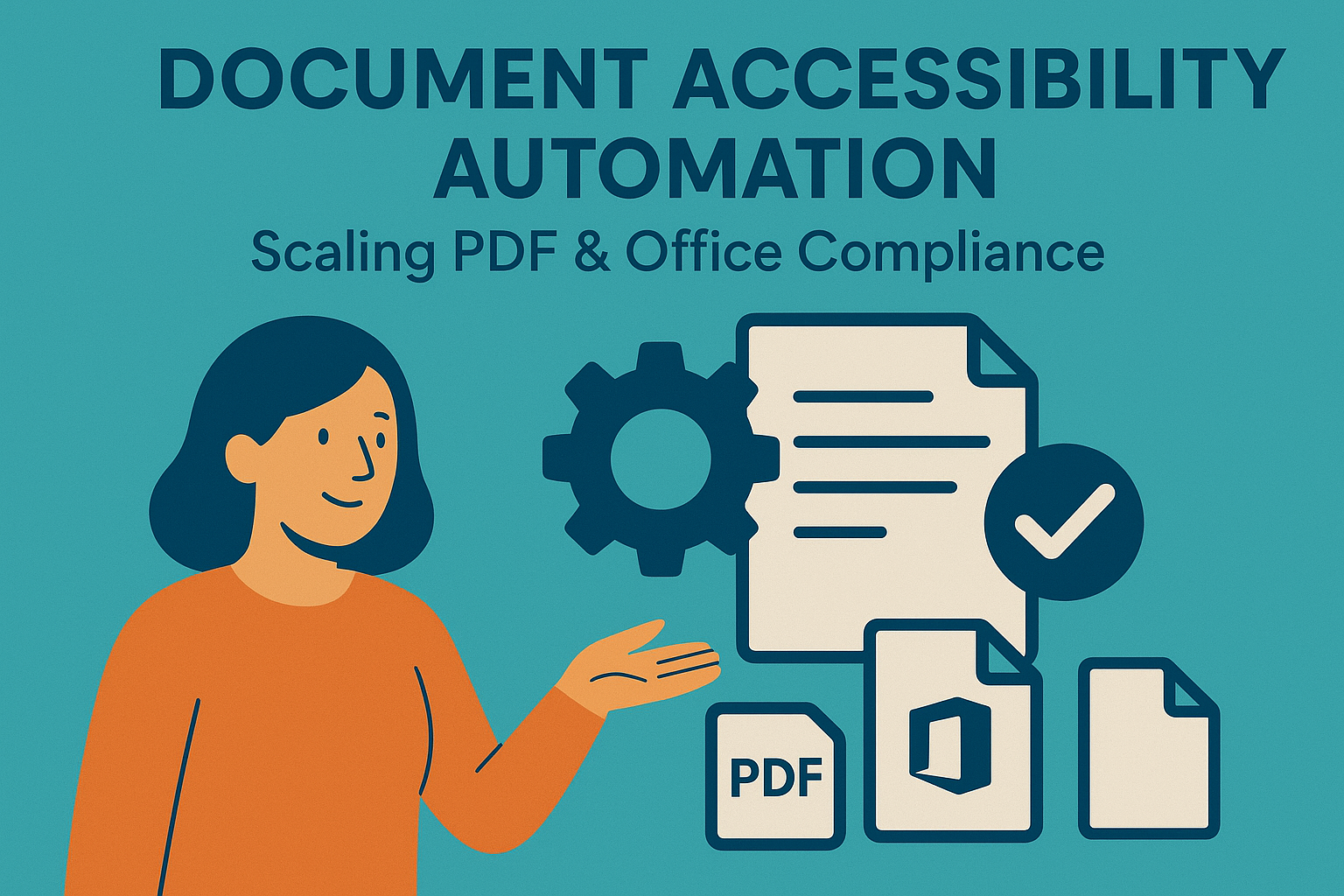
Document Accessibility Automation — Scaling PDF & Office Compliance
Document Accessibility Automation — Scaling PDF & Office Compliance
Introduction
Documents are the backbone of business communication — from presentations and contracts to reports and whitepapers. But many organizations still produce inaccessible PDFs and office files that block screen reader users and cause compliance gaps. Manual remediation at scale is inefficient. Automation changes that, enabling accessible document creation, tagging, and verification as part of your publishing or DevOps pipeline. This guide explains how to scale document accessibility compliance for PDFs and Microsoft Office files using automation and AI-powered tools.
Why Automate Document Accessibility?
- Manual tagging and testing are slow, expensive, and error-prone for large document repositories.
- Regulatory frameworks (PDF/UA, Section 508, EN 301 549) require ongoing document accessibility proofs.
- Automation ensures consistency and repeatable quality across teams and departments.
- Accelerates compliance while reducing remediation costs and legal risk over time.
Core Accessibility Requirements for Documents
Before automating, it’s important to understand what makes documents accessible under WCAG and PDF/UA.
- Tagged structure: Proper headings, lists, and table relationships.
- Reading order: Logical content flow that matches visual presentation.
- Alternative text: Concise descriptions for images and graphics.
- Visible link text: Links that describe purpose, not raw URLs.
- Metadata & language settings: Title, author, and document language identified.
Automation Approaches
1. Template-Based Accessibility
Start with accessible templates in Word, PowerPoint, and Excel before conversion to PDF.
- Define heading styles, table headers, and alt text placeholders in design templates.
- Lock branding and layout components that already meet contrast and structure rules.
- Ensure authors cannot remove essential accessibility elements (e.g., reading order layers).
2. Scripting & Batch Conversion
Use scripts to convert Office documents to tagged PDFs automatically.
powershell -command "
$files = Get-ChildItem 'C:\Reports' -Filter *.docx
foreach ($file in $files) {
  $word = New-Object -ComObject Word.Application
  $doc = $word.Documents.Open($file.FullName)
  $pdfPath = $file.FullName.Replace('.docx','.pdf')
  $doc.ExportAsFixedFormat($pdfPath, 17, $false, 0, 0, 0, 0, 7, $true, $true, 4)
  $doc.Close()
}
$word.Quit()
"
Use automation hooks to apply consistent tagging and metadata at conversion time.
3. Automated Remediation Tools
- axesPDF for Word / PDF: Performs batch tagging and structure repair.
- CommonLook PDF: Automates PDF/UA validation and reports.
- Adobe Acrobat Preflight Profiles: Detects missing tags and runs autocorrect actions via CLI commands.
- AI OCR Tools (e.g., Allyant, Foxit AIP): Extracts text and detects structure from scanned files automatically.
Accessibility QA in CI/CD Pipelines
Integrate document creation and validation into existing DevOps pipelines for continuous compliance.
# Example GitHub Actions Workflow
name: Document Accessibility Validation
on: [push]
jobs:
  validate-documents:
    runs-on: ubuntu-latest
    steps:
      - uses: actions/checkout@v3
      - name: Run PDF accessibility check
        run: |
          docker run --rm -v $PWD:/docs allyant/accessibility-auditor test /docs/*.pdf
- Automate report generation for Quality Assurance sign‑off before release.
- Set thresholds (e.g., fail build if PDF/UA validation score < 95%).
Office Add‑Ins & API Integrations
Modern office platforms allow extension through accessible API hooks and plug‑ins.
- Microsoft Accessibility Checker API: Integrate directly with SharePoint or Teams workflows to auto‑flag inaccessible docs.
- Google Workspace Add‑Ons: Use Apps Script to detect and tag images missing alt descriptions.
- Adobe PDF Library API: Automatically insert tags and ARIA‑like metadata into PDFs at export.
Metadata & Version Control Automation
Metadata management improves screen reader context and auditing speed.
- Assign titles, authors, and language using scripts or PDF preflight templates.
- Version each release with automated accessibility report records for governance audits.
exiftool -Title="2024 Accessibility Report" -Author="Accesify.io"
          -Language="en-US" -PDFUA=true example.pdf
Monitoring & Reporting Framework
- Create a document accessibility dashboard that aggregates results from automated reports.
- Visualize compliance rates over time and identify departments needing training support.
- Export quarterly compliance summaries for legal or ISO certification evidence.
Common Challenges
- Inconsistent templates: Different departments use uncoordinated document styles and tagging rules.
- Hybrid content: Scanned documents with mixed OCR accuracy require human validation post‑automation.
- Misinterpreted reading order: Complex layouts confuse auto‑tagging algorithms without manual review.
- Absence of QA process: Automated tools detect issues but no workflow exists for remediation.
Best Practices for Scalable Automation
- Start with accessible authoring templates before automation — prevention is cheaper than remediation.
- Combine AI recognition with manual sampling for continuous improvement accuracy benchmarks.
- Document automated fix limitations and plan human review for complex layouts and charts.
- Train teams on accessibility metadata and tagging requirements to maintain consistency.
Conclusion
Document accessibility automation bridges the gap between compliance and scalability. Integrating automated tagging, metadata insertion, and continuous validation into every publishing workflow ensures that accessible communication becomes routine — not reactive. By combining automation efficiency with human quality assurance, organizations can maintain PDF/UA and WCAG compliance across thousands of documents effortlessly.
Next Steps:<