Cognitive & Learning Disabilities — WCAG Criteria for Inclusive Content
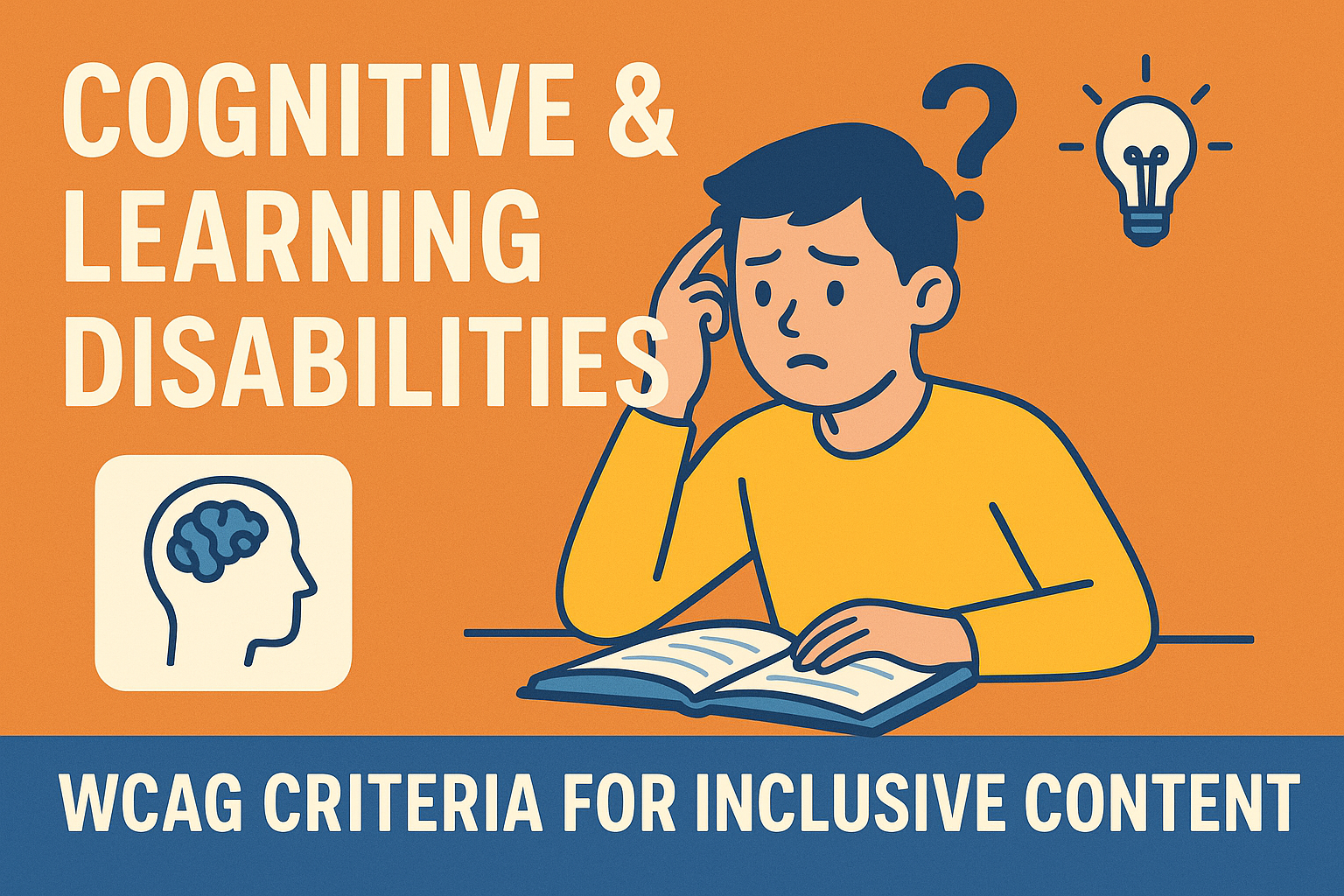
Cognitive & Learning Disabilities — WCAG Criteria for Inclusive Content
Introduction
Cognitive and learning disabilities encompass a broad range of conditions affecting how people process, remember, and communicate information. This includes users with dyslexia, ADHD, autism, short-term memory challenges, or other neurodivergent traits. According to the Web Content Accessibility Guidelines (WCAG), content must be structured and designed so that it is understandable, predictable, and easy to use — the foundation of the Understandable principle within the POUR framework (Perceivable, Operable, Understandable, Robust).
Designing with cognitive accessibility in mind benefits everyone. Simplified structure, clarity of language, and consistent layouts create content that is easier to comprehend, even for users reading new topics, in second languages, or while multitasking.
Why Cognitive Accessibility Matters
While tools like screen readers assist users with sensory disabilities, cognitive inclusion depends on predictable interactions, simplified structure, and clear communication. Barriers such as jargon-filled text, confusing forms, or unexpected page changes can make otherwise functional websites unusable for neurodivergent people.
- 9 – 15 % of the global population has dyslexia or reading difficulty.
- 1 in 7 people are neurodivergent, including autism and attention differences.
- Accessible, predictable design reduces error rates and abandonment across all demographics.
Crafting content for cognitive diversity ensures equitable access to information, improving comprehension and reducing frustration for everyone.
Relevant WCAG 2.2 Success Criteria
3.1.5 — Reading Level (AAA)
Text should not require reading ability greater than the lower secondary education level, or an alternate simplified version should be provided.
3.2.3 — Consistent Navigation (AA)
Navigation components repeated across pages must appear in the same relative order so users can locate items efficiently through muscle memory.
3.2.4 — Consistent Identification (AA)
Elements with the same function — like search boxes or submit buttons — must be labeled consistently throughout the site to avoid confusion.
3.3.2 — Labels or Instructions (A)
Forms and controls should provide clear labels and directions before user interaction to prevent guessing and reduce errors.
3.3.3 — Error Suggestion (AA)
When users make mistakes, suggest specific corrections rather than generic messages so they can adjust inputs appropriately.
3.3.6 — Error Prevention (All Data) (AAA)
For data that cannot be easily changed once submitted (financial or legal information), implement confirmation screens and easy undo options to minimize anxiety and cognitive load.
2.2.1 — Timing Adjustable (A)
Provide users enough time to read and complete tasks — or offer ways to adjust, pause, or extend timeouts.
Designing for Cognitive and Learning Accessibility
1. Simplify Content
- Use plain language and avoid technical jargon when possible.
- Break complex ideas into short paragraphs with descriptive headings.
- Use ordered lists and number steps for processes so users can track progress.
- Complement text with simple visuals or icons to aid understanding and memory.
2. Create Predictable Navigation
- Keep menus and site layout consistent across pages.
- Use breadcrumb trails to show location within a hierarchy.
- Place search and login controls in the same spot throughout the site.
- Avoid sudden content shifts or automated page redirects that disrupt focus.
3. Design Forms for Reduced Cognitive Load
- Provide clear instructions above each input field on what to enter.
- Group related questions with headings and logical order.
- Use inline validation and immediate error communication when fields are incomplete or invalid.
- Allow copy‑pasting of data such as addresses to avoid redundant typing.
4. Support Focus and Attention
- Provide visible keyboard focus highlights on interactive elements.
- Minimize flashing or moving content that distracts or overstimulates users.
- Create chunked sections of information and summaries for long articles.
- Use white space and clear line spacing to help the eye track easily.
Content Writing for Cognitive Accessibility
- Use short, active sentences and common vocabulary.
- Define abbreviations and acronyms on first use.
- Provide summaries or “key takeaway” boxes for pages with dense information.
- Use consistent tone and voice so users don’t need to reinterpret the style each time they read.
- Make links self‑descriptive (avoid “click here,” use specific phrases like “read the shipping policy”).
Visual and Interactive Support for Cognitive Inclusion
- Provide icons with text labels to reinforce meaning through multiple channels (e.g., a trash icon labeled “Delete”).
- Ensure buttons and links are large enough for accurate activation (24 × 24 px minimum).
- Offer the option to toggle simplified layouts or high‑contrast modes.
- Break multi‑step tasks (such as checkouts) into visible stages with clear progress indicators.
Testing for Cognitive Accessibility
Automated tools can only detect technical issues — evaluating cognitive accessibility requires human review and user feedback. Conduct usability testing with neurodiverse participants to identify patterns of confusion and clarify content.
- Observe navigation patterns — do users hesitate, scroll repeatedly, or ask for clarification?
- Ask participants to explain meaning in their own words — comprehension proves clarity better than speed alone.
- Collect feedback on terminology, information density, and page flow to inform improvements.
Common Barriers for Cognitive & Learning Accessibility
- Complex sentences and jargon: Simplify language and explain concepts plainly.
- Overloaded layouts: Use white space and reduce distractions like autoplay or banner animation.
- Unexpected navigation changes: Avoid automatic redirects or pop‑ups triggered on focus change.
- Unclear errors or instructions: Make directions specific and location based: “Enter your postal code in the Address section.”
Checklist for Cognitive & Learning Accessibility
- ✅ Plain‑language content written at a lower secondary reading level (3.1.5)
- ✅ Navigation consistent site‑wide (3.2.3)
- ✅ Labels clear and persistent (3.3.2)
- ✅ Form errors identified and suggestions provided (3.3.3)
- ✅ Animations and distractions limited or pausable (2.2 series)
- ✅ Instructions and feedback immediate and contextual
Conclusion
Making digital experiences accessible for users with cognitive and learning disabilities is fundamentally about clarity, simplicity, and predictability. WCAG criteria — particularly those in Guideline 3.1 (Readable), 3.2 (Predictable), and 3.3 (Input Assistance) — give actionable controls to achieve these goals. When content is easy to understand and remember, the entire user population benefits.
Next steps: Audit your content readability and interaction flow against WCAG 2.2 criteria. Simplify language, standardize navigation, and introduce structured help to make your site truly inclusive for users with cognitive and learning differences.