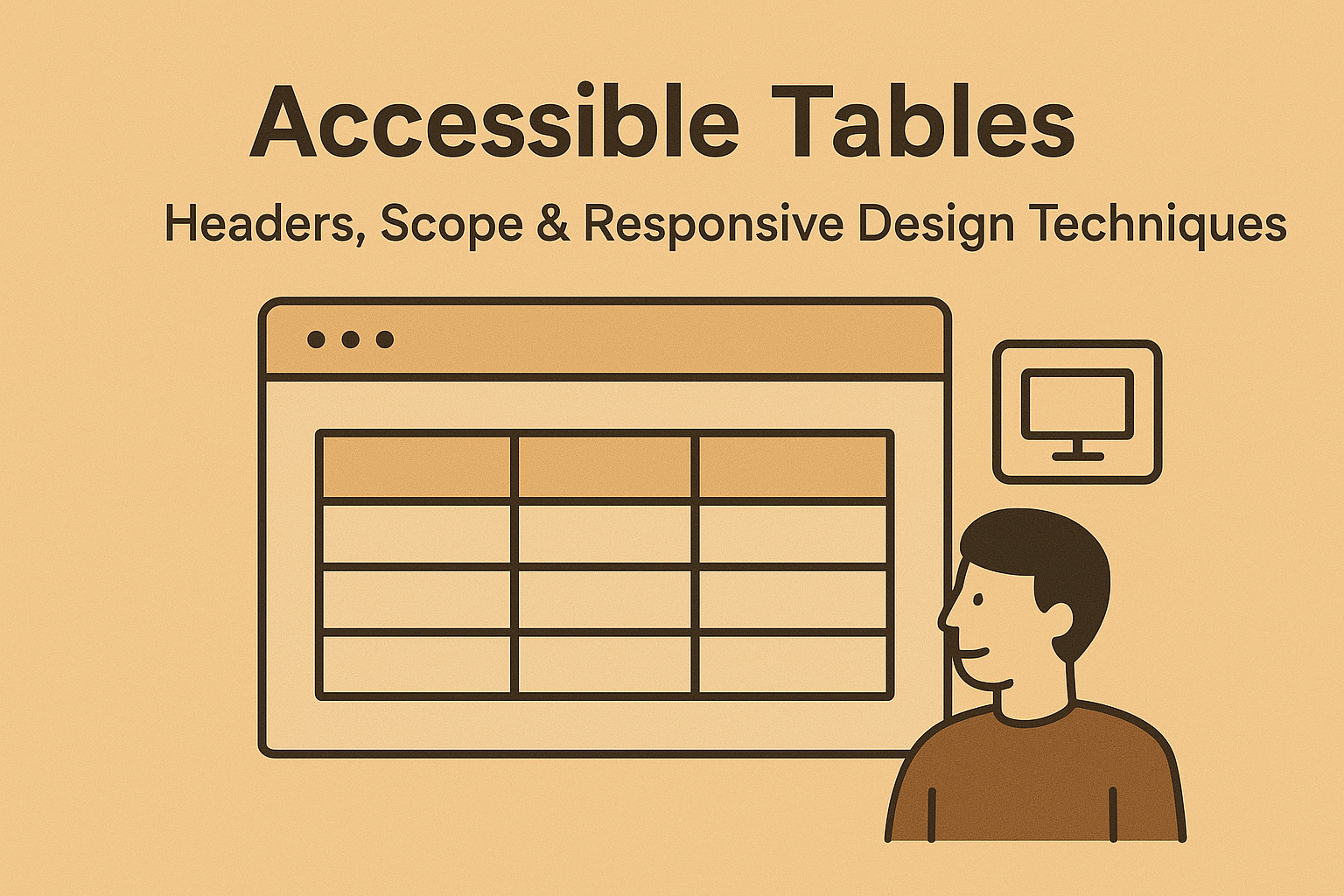
Accessible Tables — Headers, Scope & Responsive Design Techniques
Accessible Tables — Headers, Scope & Responsive Design Techniques
Introduction
Tables are ideal for organizing structured data — not for page layout. However, many data grids and responsive designs neglect accessibility, leaving screen reader users struggling to connect headers with cells. Accessible tables rely on semantic HTML, the correct use of scope attributes, and thoughtful responsive behavior. This ensures your data remains readable and meaningful across all devices and assistive technologies.
WCAG 2.2 Success Criterion 1.3.1 (Info and Relationships) explicitly requires that content relationships — such as headers and data cells — are programmatically determinable. Achieving this makes tables universally comprehensible.
Why Table Accessibility Matters
- Screen readers interpret data cell context through their associated headers.
- Responsive layouts can hide or rearrange content, breaking logical reading order.
- Clear semantics improve usability for everyone, including keyboard and mobile users.
Basic Accessible Table Structure
Use <table> for data relationships, not layout. Define headers with <th> and associate cells to these headers using the scope attribute.
<table>
  <caption>Monthly Sales Report</caption>
  <thead>
    <tr>
      <th scope="col">Month</th>
      <th scope="col">Sales</th>
      <th scope="col">Growth</th>
    </tr>
  </thead>
  <tbody>
    <tr>
      <th scope="row">January</th>
      <td>$10,000</td>
      <td>+5%</td>
    </tr>
    <tr>
      <th scope="row">February</th>
      <td>$12,500</td>
      <td>+8%</td>
    </tr>
  </tbody>
</table>
- <caption> provides a descriptive title for the table.
- scope="col" and scope="row" ensure assistive technologies know which headers apply to each cell.
Advanced Header Associations
In complex tables with multi‑level headers, use id and headers attributes to explicitly associate cells.
<table>
  <caption>Quarterly Performance</caption>
  <thead>
    <tr>
      <th id="quarter">Quarter</th>
      <th id="region">Region</th>
      <th id="sales">Sales</th>
    </tr>
  </thead>
  <tbody>
    <tr>
      <td headers="quarter region sales">Q1 North</td>
      <td headers="sales">$30,000</td>
    </tr>
  </tbody>
</table>
This explicit relationship mapping supports complex data structures, especially when tables are generated dynamically or use multiple grouping layers.
Caption & Summary Techniques
- The
<caption>should be concise and informative, describing the data’s purpose. - A brief introduction paragraph before the table helps contextualize what users are viewing.
- In ARIA, the
role="table"oraria-labelledbyattributes may supplement native semantics when necessary.
Responsive Design for Tables
Responsive design often presents challenges for maintaining accessibility. Avoid stacking or hiding columns in ways that lose relationships. Consider these patterns:
1. Scrollable Table Wrapper
Preserves table semantics while allowing horizontal scroll on smaller screens.
<div class="table-container">
  <table>...</table>
</div>

.table-container {
  overflow-x: auto;
}
2. Reflow Pattern
Converts tables to key-value layouts while keeping header context accessible.
<div class="table-row">
  <div class="table-header">Month</div>
  <div class="table-cell">January</div>
</div>
If using a reflow pattern, include appropriate aria-label or aria-labelledby for each data-cell grouping to preserve relationships.
ARIA Roles for Advanced Widgets
When using styled or grid-like components, native semantics may be overridden inadvertently. Restore accessibility using ARIA roles:
role="table"— Defines a tabular relationship (use sparingly if not using native<table>).role="row"androle="cell"— Used for SPA or framework-rendered data grids.aria-colindexandaria-rowindex— Specify cell positions in dynamic grids.
Best Practices
- Use semantic elements first; resort to ARIA roles only when necessary.
- Always provide captions and headers for context.
- Avoid hiding headers or reordering cells responsively.
- Ensure sufficient color contrast in bordered or striped tables.
- Enable keyboard navigation for interactive tables or data grids.
Testing Accessible Tables
Validation involves both automated and manual methods:
- Use screen readers (NVDA or VoiceOver) to ensure correct header announcements.
- Verify focus and navigation orders align visually and logically.
- Test responsive patterns on mobile and desktop to confirm structural integrity.
- Validate with automated tools like WAVE and axe DevTools for missing captions or malformed headers.
Common Accessibility Errors in Tables
- Using tables for layout: Breaks logical reading and structural relationships.
- Missing <th> scope values: Causes screen readers to misinterpret data associations.
- Disappearing or rearranged columns: Responsive transformations hide context.
- Repeated, redundant ARIA roles: Overuse of
role="grid"adds noise to announcements.
Conclusion
Accessible tables honor both structure and meaning. By combining semantic HTML with captions, headers, and responsive best practices, you ensure that data remains usable and understandable for all audiences. Accessibility transforms raw information into usable insight — for everyone.
Next Steps: Audit your tables for proper header relationships, review responsive behaviors for integrity, and adopt pattern libraries with accessibility built in from the start.