
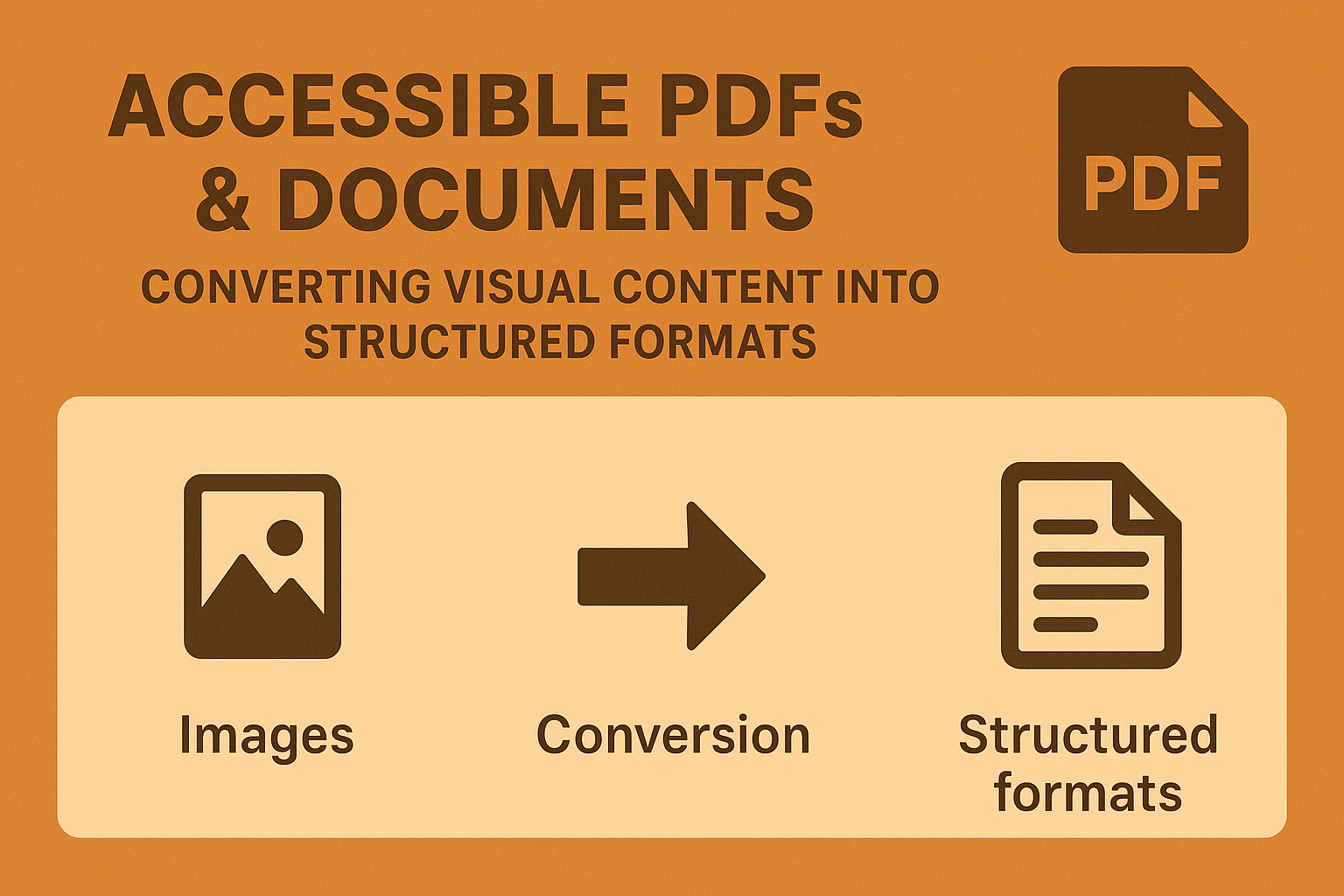
Accessible PDFs & Documents — Converting Visual Content into Structured Formats
Accessible PDFs & Documents — Converting Visual Content into Structured Formats
Introduction
Documents and PDFs remain a vital part of digital communication — from reports and forms to brochures and policies. However, when exported or designed without accessibility structure, these files can become unusable for people relying on assistive technologies. Accessible documents combine visual presentation with programmatic structure, ensuring screen readers and other tools can interpret the content correctly.
Following WCAG 2.2 and PDF/UA (ISO 14289‑1) standards, accessible PDFs use semantic tagging, accurate reading order, and textual alternatives for a fully inclusive experience.
Why PDF Accessibility Is Important
- Screen readers depend on underlying tags to interpret headings, lists, tables, and paragraphs.
- Tagged PDFs improve indexing and searchability within digital libraries.
- Accessible documents meet compliance with ADA, Section 508, and European EN 301 549 standards.
Core Elements of an Accessible PDF
Every accessible PDF begins with structural tagging and descriptive information:
- Tag tree: Defines headings, paragraphs, lists, and tables.
- Reading order: Ensures logical content flow for screen readers.
- Alt text: Describes images, charts, and logos.
- Document metadata: Specifies title, language, and author for context.
Creating Tagged PDFs from Authoring Tools
Most design or document platforms can export accessible PDFs, but only when configured properly:
Microsoft Word / PowerPoint
- Use built‑in Styles (e.g., Heading 1, Heading 2) for consistent structure.
- Set document language and title under File → Info → Properties.
- Run the built‑in Accessibility Checker before exporting.
- Export via File → Save As → PDF → Options → Document structure tags for accessibility.
Adobe InDesign
- Use paragraph and object styles consistently across elements.
- Add alt text in the Object Export Options panel.
- Set reading order in the Articles panel before export.
- Under Export → Adobe PDF (Interactive or Print), enable “Create Tagged PDF.”
Adding Accessibility to Existing PDFs
For legacy or scanned PDFs, remediation tools can add missing structure and improve compliance.
- Adobe Acrobat Pro: Use Tools → Accessibility → Autotag Document and check the reading order panel.
- CommonLook PDF: Advanced compliance tool for PDF/UA validation and remediation.
- Axes4 PDF Checker or PAC 3: Free validation tools for testing tag structure and language settings.
<Tags>
  + Document
    + H1 (Accessibility Annual Report 2024)
    + P  (Summary of accessibility metrics and progress)
    + Table (Key findings)
</Tags>
This tag structure determines how assistive technology reads the file’s contents.
Ensuring Correct Reading Order
In complex layouts (columns, sidebars, or images with captions), the visual order may differ from the logical structure. Use Acrobat’s “Reading Order” tool to check the flow. Ensure it follows a top‑to‑bottom, left‑to‑right pattern matching the on‑screen presentation.
Alternative Text and Links
- Add alt text for all meaningful non-text objects (images, charts, and graphics).
- Decorative elements should be marked as “Artifacts” to be ignored by screen readers.
- Ensure links include descriptive text instead of raw URLs (e.g., “View Accessibility Report” rather than “https://example.com/report.pdf”).
<Link>
  <Caption>Review our accessibility guidelines</Caption>
  <Reference>https://example.com/accessibility</Reference>
</Link>
Tables and Lists in PDFs
Mark up tables with proper headers using <TH> and Scope attributes inside the tag tree. Avoid merged or split cells that disrupt screen reader logic. Ordered and unordered lists should contain numbered (<L>) or bullet (<LI>) tags in the logical structure tree.
Document Title and Metadata
Assistive technologies use document metadata for orientation. Set the document title and mark Display Document Title under Acrobat File Properties → Description. Define the language under Advanced Properties → Reading Options.
Title: Accessibility Strategy Whitepaper 2024
Language: en-US
Author: Accesify Team
Tagged PDF: Yes
Testing PDF Accessibility
- Open the Tags panel in Acrobat to verify structural hierarchy.
- Use screen readers (NVDA, JAWS) to review how headers, lists, and tables are announced.
- Run accessibility checks with PAC 3 or Adobe’s Accessibility Checker.
- Confirm links, titles, and alt text read naturally in context.
Common PDF Accessibility Issues
- Untagged PDFs: Screen readers treat them as unstructured images.
- Incorrect reading order: Users hear data out of sequence.
- Missing alt text: Important visuals lack explanations.
- Scanned PDFs without OCR: Text locked as images prevents assistive access.
Conclusion
Accessible PDFs transform static documents into structured, interactive, and inclusive resources. By tagging content, establishing reading order, and providing alt text, every reader — regardless of ability or technology — can engage effectively with your documents. Accessibility compliance isn’t just a checkbox; it’s a commitment to equality and usability across all formats.
Next Steps: Review your document workflow for accessibility tagging standards. Automate checks during export and use tools like PAC 3 or Acrobat Pro to validate before publishing.