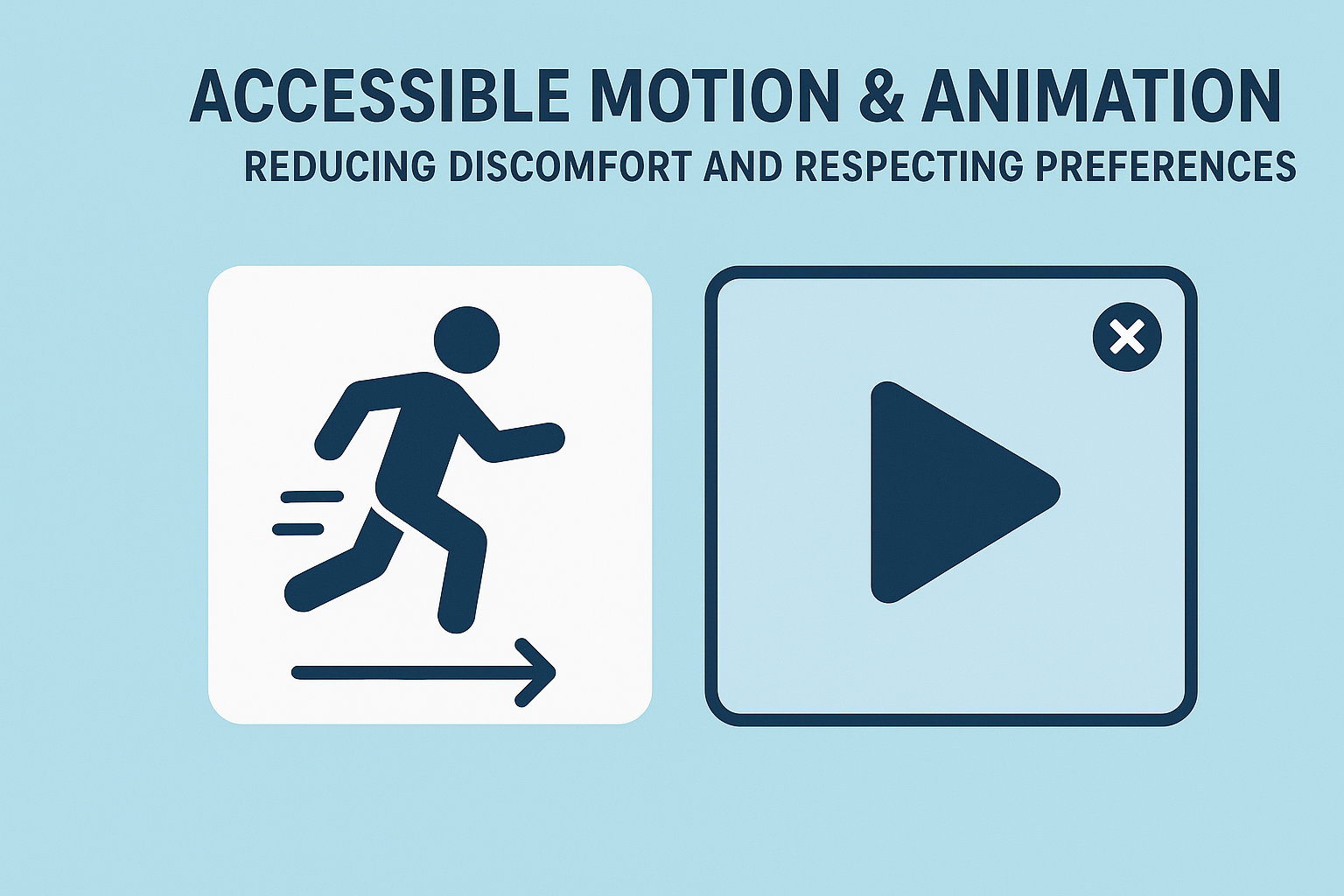
Accessible Motion & Animation — Reducing Discomfort and Respecting Preferences
Accessible Motion & Animation — Reducing Discomfort and Respecting Preferences
Introduction
Animations and motion-based interactions enrich modern web experiences. They guide focus, provide feedback, and express brand personality. However, excessive or uncontrolled motion can trigger dizziness, nausea, or cognitive overload for some users. Accessibility ensures animations enhance usability, not interfere with comfort. Following WCAG 2.2 Success Criterion 2.3.3 (Animation from Interactions), developers must provide a way to disable or minimize animations that might cause harm or distraction.
Why Accessible Motion Matters
Motion isn’t just visual — it directly affects user comfort and comprehension. Some individuals experience vestibular disorders or sensitivity to motion, making animated elements problematic. Respecting user preferences around animation enhances inclusion and focus for all users.
- Preserves clarity and focus by minimizing unnecessary distractions.
- Prevents motion-triggered nausea or dizziness for sensitive users.
- Improves cognitive flow and overall readability.
- Aligns with user-system settings through
prefers-reduced-motion.
Understanding prefers-reduced-motion
The prefers-reduced-motion media query allows developers to tailor animations based on user preferences at the operating system level.
@media (prefers-reduced-motion: reduce) {
  * {
    animation-duration: 0.01ms !important;
    animation-iteration-count: 1 !important;
    transition-duration: 0.01ms !important;
  }
}
If a user has enabled “Reduce Motion” in their system settings, this query automatically applies, minimizing or disabling non-essential motion across your site.
Best Practices for Accessible Animation
- Use motion purposefully: Apply animation only to reinforce meaning or feedback (e.g., button state changes or loading cues).
- Provide context: Avoid abrupt changes that cause disorientation.
- Use opacity and transform transitions: Subtle fades and slides are less disruptive than parallax or zoom.
- Offer controls: Provide “Turn off animations” or “Reduce motion” options in accessibility settings.
Techniques for Reducing Motion
1. Subtle Microinteractions
Keep animations minimal. Instead of large translations, use small transform increments:
button {
  transition: background-color 0.2s ease, transform 0.2s ease;
}
2. Replace Movement with Fading
Fade effects reduce visual strain while maintaining feedback:
.alert {
  transition: opacity 0.3s ease;
  opacity: 1;
}
.alert.hidden {
  opacity: 0;
}
3. Pause or Stop Motion Automatically
Ensure looping animations or marquees can be paused or stopped by users:
<div role="marquee">
  <button onclick="pauseAnimation()">Pause Motion</button>
</div>
This meets WCAG 2.2 Criterion 2.2.2 (Pause, Stop, Hide).
Accessibility Considerations for Motion
- Avoid parallax scrolling or background motion that moves independently of user input.
- Prevent flashing or blinking elements exceeding three times per second to avoid triggering seizures (WCAG 2.2 Criterion 2.3.1).
- Use easing functions (
ease-in-out) for smoother transitions rather than sharp motion. - Test both animated and reduced-motion modes to ensure parity of information.
Testing Animation Accessibility
Evaluate your animations in various environments:
- Enable “Reduce Motion” in macOS, Windows, Android, and iOS accessibility settings.
- Use browser DevTools to simulate
prefers-reduced-motion. - Confirm that visual cues remain intact (e.g., state changes, navigation feedback).
- Gather user feedback regarding motion sensitivity or disorientation.
Common Accessibility Errors
- Ignoring user preferences: Animations continue even when
prefers-reduced-motionis enabled. - Excessive looping effects: Repeated or infinite animations draw user attention away from tasks.
- Flash frequency issues: Uncontrolled blinking elements can trigger photosensitive reactions.
- Context mismatch: Key content revealed only through animation, making it inaccessible to some users.
Conclusion
Accessible motion design respects comfort, control, and comprehension. By aligning animations with user preferences, developers and designers create more inclusive experiences. Subtle, meaningful motion enhances usability — while respecting health and focus.
Next Steps: Review existing animations, implement prefers-reduced-motion media queries, and test your site in multiple user settings to ensure motion helps — never harms — accessibility.