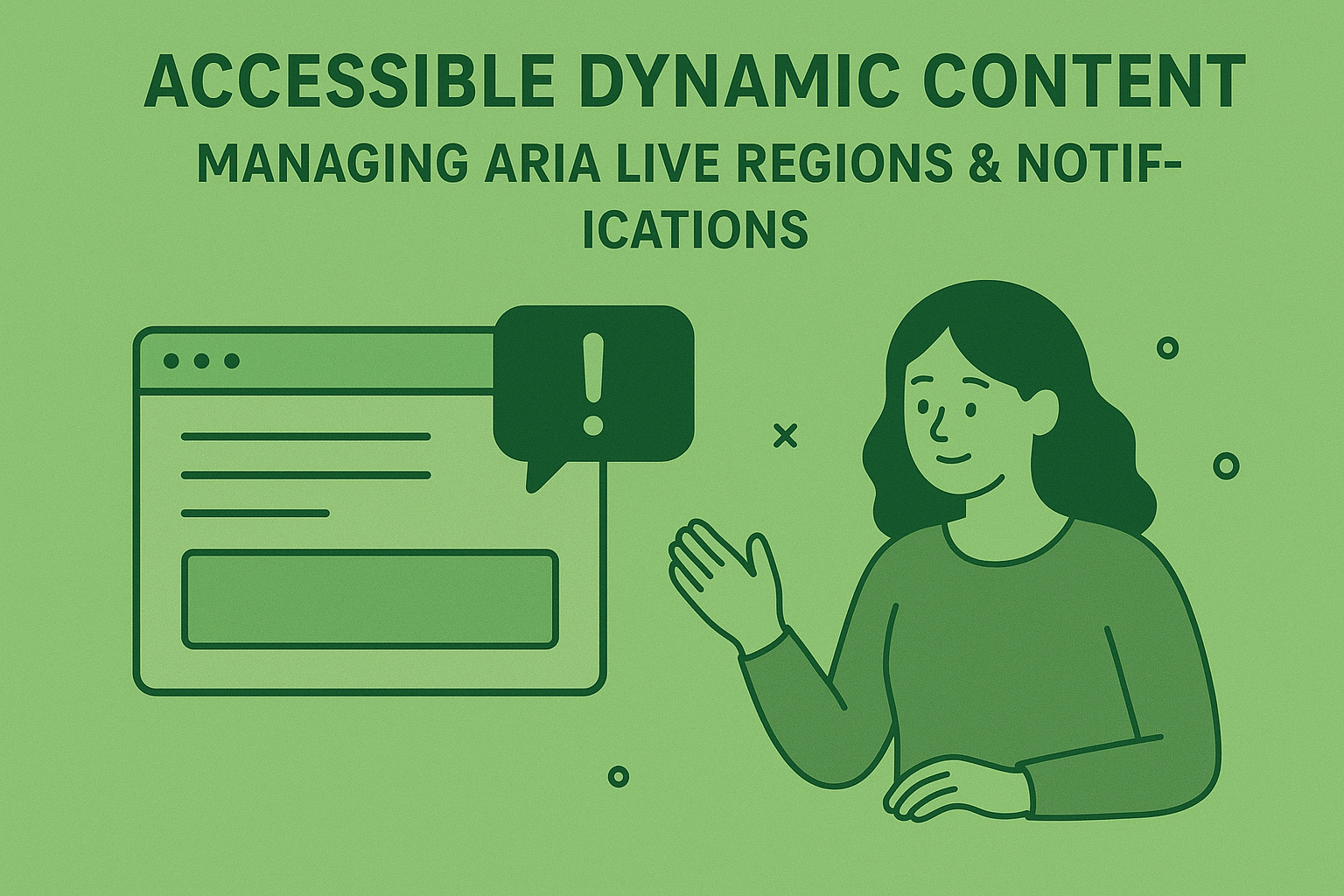
Accessible Dynamic Content — Managing ARIA Live Regions & Notifications
Accessible Dynamic Content — Managing ARIA Live Regions & Notifications
Introduction
Modern web interfaces often rely on dynamic content updates — such as form validations, notifications, status messages, or live data feeds — to enhance usability and responsiveness. However, when these changes are announced visually only, users relying on assistive technologies like screen readers may never perceive them. This can cause confusion and usability breaks in otherwise functional applications.
To make dynamic updates accessible, developers use ARIA live regions, an essential WAI-ARIA technique that informs assistive technologies whenever content updates occur. This ensures timely and contextual announcements that keep users oriented as the interface changes.
Why ARIA Live Regions Are Important
Dynamic content can appear or change without any keyboard or focus interaction. Without clear announcements, these updates are invisible to screen reader users. ARIA live regions serve as the broadcast system for accessibility — narrating events that occur outside of a user’s current focus area.
- Ensures that time-sensitive changes (e.g., error messages or live scores) are announced automatically.
- Improves situational awareness and reduces confusion for non-visual users.
- Aligns with WCAG 2.2 Success Criterion 4.1.3 (Status Messages) for accessible system feedback.
Understanding ARIA Live Region Attributes
ARIA attributes allow developers to define how assistive technologies should respond to content updates within specific containers. Here are the most common properties:
- aria-live="polite" — Announces updates when the user is idle (used for low-priority messages).
- aria-live="assertive" — Announces updates immediately, interrupting current speech (used for critical information).
- aria-atomic="true" — Ensures the entire region is read instead of just the changed portion.
- aria-relevant="additions | text | all" — Controls which types of DOM changes trigger announcements.
Examples of Accessible Dynamic Content
1. Form Validation and Error Notifications
When a user submits a form with missing fields, error messages should be announced instantly:
<div aria-live="assertive" class="error-msg">Email field is required.</div>2. Status Updates or Success Messages
For non-critical messages like “Item added to cart,” use a polite live region:
<div aria-live="polite" class="status-msg">Item successfully added to cart.</div>3. Live Feeds or Notifications
News, chat, or stock tickers can use live regions carefully to avoid overwhelming users:
<div aria-live="polite" aria-atomic="true">Latest stock update: Company XYZ rises 5%.</div>
Best Practices for Implementing ARIA Live Regions
- Use live regions sparingly — unnecessary updates can overwhelm or annoy users.
- Only set
aria-live="assertive"for urgent content like errors or alerts. - Ensure visible updates accompany announcements; users who can see and hear both benefit most.
- Confirm messages are inserted directly into the DOM, not just altered visually via CSS.
- Test behavior with multiple screen readers (JAWS, NVDA, VoiceOver, TalkBack).
Testing ARIA Live Regions
Verify proper announcements by using assistive technologies directly:
- Turn on a screen reader (e.g., NVDA or VoiceOver).
- Trigger dynamic actions — form submissions, loading indicators, or alerts.
- Observe whether updates are announced automatically and appropriately.
For automation, tools like axe DevTools can flag missing ARIA attributes or improper region configurations.
Common Mistakes & How to Avoid Them
- Overuse of assertive regions: Constant interruptions make experiences frustrating.
- Dynamically hidden messages: Use
visibility:hiddencautiously — screen readers can’t announce what’s not in the accessibility tree. - Incorrect placement: Place live regions outside of focusable components for consistent announcements.
Conclusion
ARIA live regions bridge the communication gap between dynamic web content and users relying on assistive technology. By using the correct roles, attributes, and tested patterns, you ensure that every user receives the same timely updates and feedback — creating more inclusive and understandable digital experiences.
Next Steps: Audit your interfaces for unannounced updates, implement live regions with proper priority levels, and include screen reader testing in your CI/CD workflow for continuous accessibility assurance.