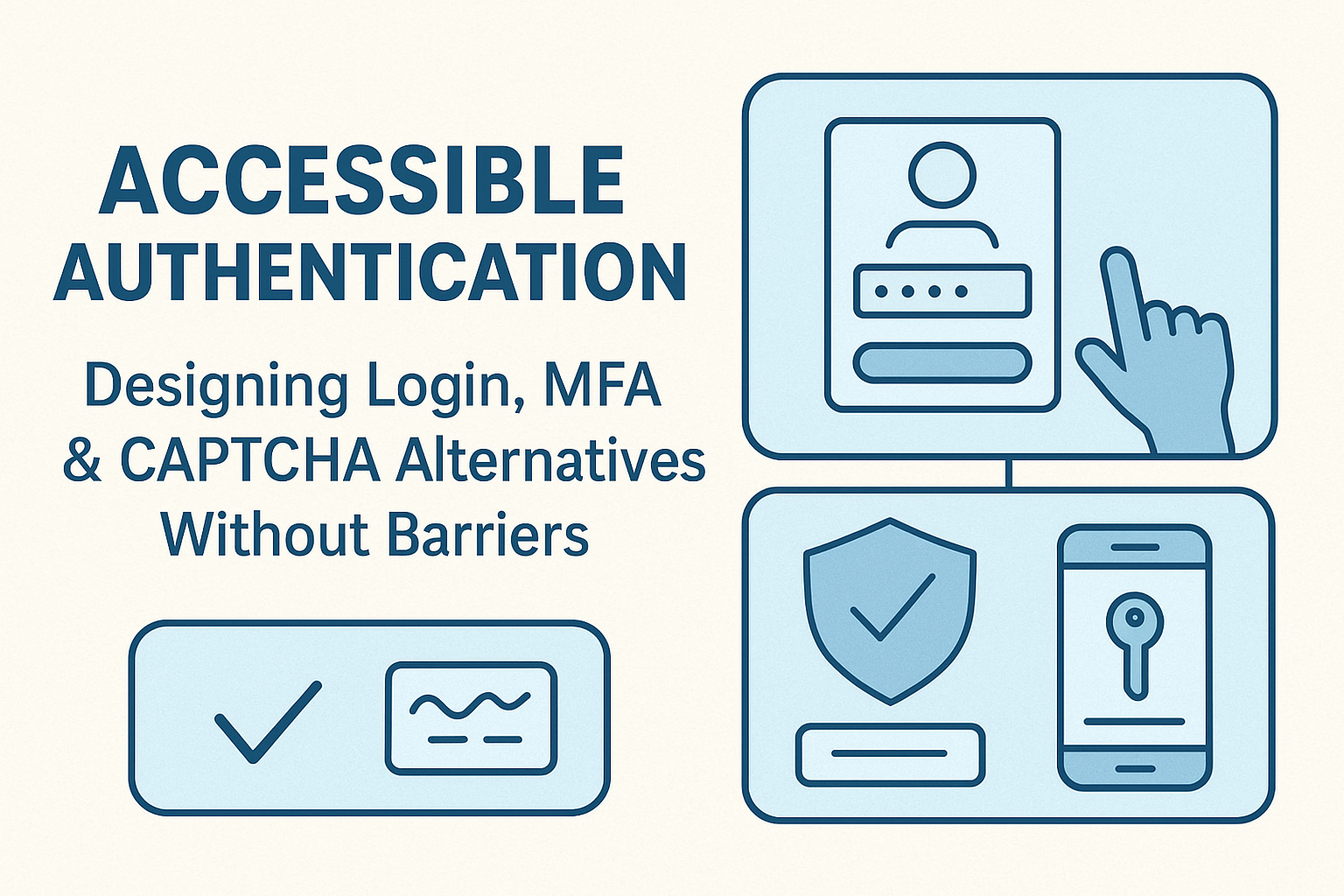
Accessible Authentication — Designing Login, MFA & CAPTCHA Alternatives Without Barriers
Accessible Authentication — Designing Login, MFA & CAPTCHA Alternatives Without Barriers
Introduction
Authentication is a critical step in almost every digital experience, yet it often introduces significant accessibility barriers. Visual CAPTCHAs, complex password rules, and inaccessible multi‑factor authentication (MFA) flows can block users who rely on assistive technologies or have cognitive or motor limitations. Accessible authentication ensures that everyone — regardless of ability — can sign in securely and independently.
WCAG 2.2 introduces Success Criterion 3.3.8 (Accessible Authentication), requiring that completing authentication not depend on cognitive memory or pure sensory perception. This evolution reshapes login design from being secure only to being secure and inclusive.
Why Accessible Authentication Matters
- Prevents lockout scenarios for users who cannot complete visual or audio CAPTCHAs.
- Ensures independence in identity verification without relying on assistance.
- Improves security compliance by enabling all users to complete secure flows effectively.
Accessibility and security are complementary — inclusivity builds trust and usability strengthens protection.
Common Accessibility Barriers in Authentication
- Visual CAPTCHAs: Force users to identify distorted text or images.
- SMS‑based MFA: Not perceivable for users who cannot view or operate mobile devices.
- Unlabeled form inputs: Screen readers fail to announce purpose or requirements.
- Session timeouts: Allow too little time for users with fine‑motor slowdowns.
- Complex password rules: Require memorization or pattern recall beyond cognitive limits.
Accessible Login Form Structure
Begin with semantic, properly labeled inputs and clear error messages.
<form aria-labelledby="loginTitle">
  <h2 id="loginTitle">Sign In</h2>
  <label for="email">Email address</label>
  <input type="email" id="email" name="email" required />

  <label for="password">Password</label>
  <input type="password" id="password" name="password"
         autocomplete="current-password" required />

  <button type="submit">Sign In</button>
</form>
- Use explicit
<label>associations for every field. - Announce validation feedback with
aria-live="assertive"when errors appear. - Provide instructions above fields instead of inline placeholders.
Accessible Multi‑Factor Authentication (MFA)
MFA enhances security but must remain operable by all users. Multiple channel options increase inclusion and reliability.
- Offer text, voice call, TOTP apps, or email codes — not SMS only.
- Ensure the input field for verification codes is focusable and labeled independently.
- Announce timers or expiration messages via
aria-live="polite". - Provide sufficient time extension controls for users who need longer intervals.
<label for="otp">Verification code</label>
<input
  id="otp"
  inputmode="numeric"
  aria-describedby="otpHelp"
  autocomplete="one-time-code"
/>
<div id="otpHelp">Enter the six‑digit code we sent to your registered device.</div>
Accessible CAPTCHA Alternatives
CAPTCHAs should never depend solely on perception (visual or auditory). Consider human‑verification methods that maintain accessibility and security:
- Honeypot fields: Hidden form inputs that bots fill, users don’t see.
- Time‑based checks: Measure realistic completion duration instead of visual puzzles.
- reCAPTCHA v3 or turnstile alternatives: Use behavioral risk analysis without user challenge.
- Accessible text CAPTCHAs: Offer text questions (e.g., “Type the color of the sky”).
If using image‑based CAPTCHAs, always provide equivalent text‑based options and clear instructions linked with aria-describedby.
Passwordless & Cognitive‑Friendly Authentication
Modern sign‑in methods like WebAuthn (FIDO 2) remove cognitive friction while enhancing security.
- Support biometric logins (fingerprint or face) where available and usable.
- Enable “Magic Link” emails that sign users in without complex passwords.
- Offer password visibility toggles with accessible labels (e.g., “Show password”).
- Use
<input type="email" autocomplete="username">to reduce memory dependency.
Error Messages & Recovery
Error feedback should be specific, clearly associated with each field, and discoverable by assistive technologies.
<div role="alert" id="error-summary">
  <h2>There were problems with your sign‑in</h2>
  <ul>
    <li><a href="#email">Email address is required</a></li>
    <li><a href="#password">Password must be 8 characters minimum</a></li>
  </ul>
</div>
- Associate error text via
aria-describedby. - Announce updates through polite live regions when possible.
WCAG 2.2: Accessible Authentication (3.3.8)
The criterion prohibits requiring cognitive tasks like remembering passwords, solving puzzles, or recalling patterns from memory. Compliant alternatives include:
- Passwordless login via token or link.
- Biometric or security‑key sign‑in.
- Password managers with autocomplete enabled.
- Single‑sign‑on (SSO) with accessible identity providers.
Testing Authentication Accessibility
- Run through all sign‑in steps using only a keyboard.
- Confirm labels, descriptions, and error messages are announced by screen readers.
- Evaluate MFA timeouts and resending mechanisms for sufficient duration.
- Use WAVE and axe DevTools to spot missing labels or invalid ARIA states.
- Simulate low‑vision and cognitive users to test clarity and flow.
Common Accessibility Mistakes
- Image‑only CAPTCHAs: Block non‑visual users completely.
- Missing input labels: Screen readers announce only “edit text.”
- Short timeout sessions: Disabled users must restart repeatedly.
- Hardcoded SMS‑only MFA: Excludes users without phones or with limited dexterity.
Conclusion
Accessible authentication makes security a shared right, not a barrier. By replacing vision‑dependent methods, offering flexible verification, and designing consistent focus and error patterns, teams can deliver dependable, inclusive login flows for everyone. Accessibility in authentication strengthens both trust and compliance — a win for users and organizations alike.
Next Steps: Review your login workflows, replace CAPTCHAs with inclusive alternatives, and implement WCAG 2.2 Accessible Authentication principles at every point of verification.