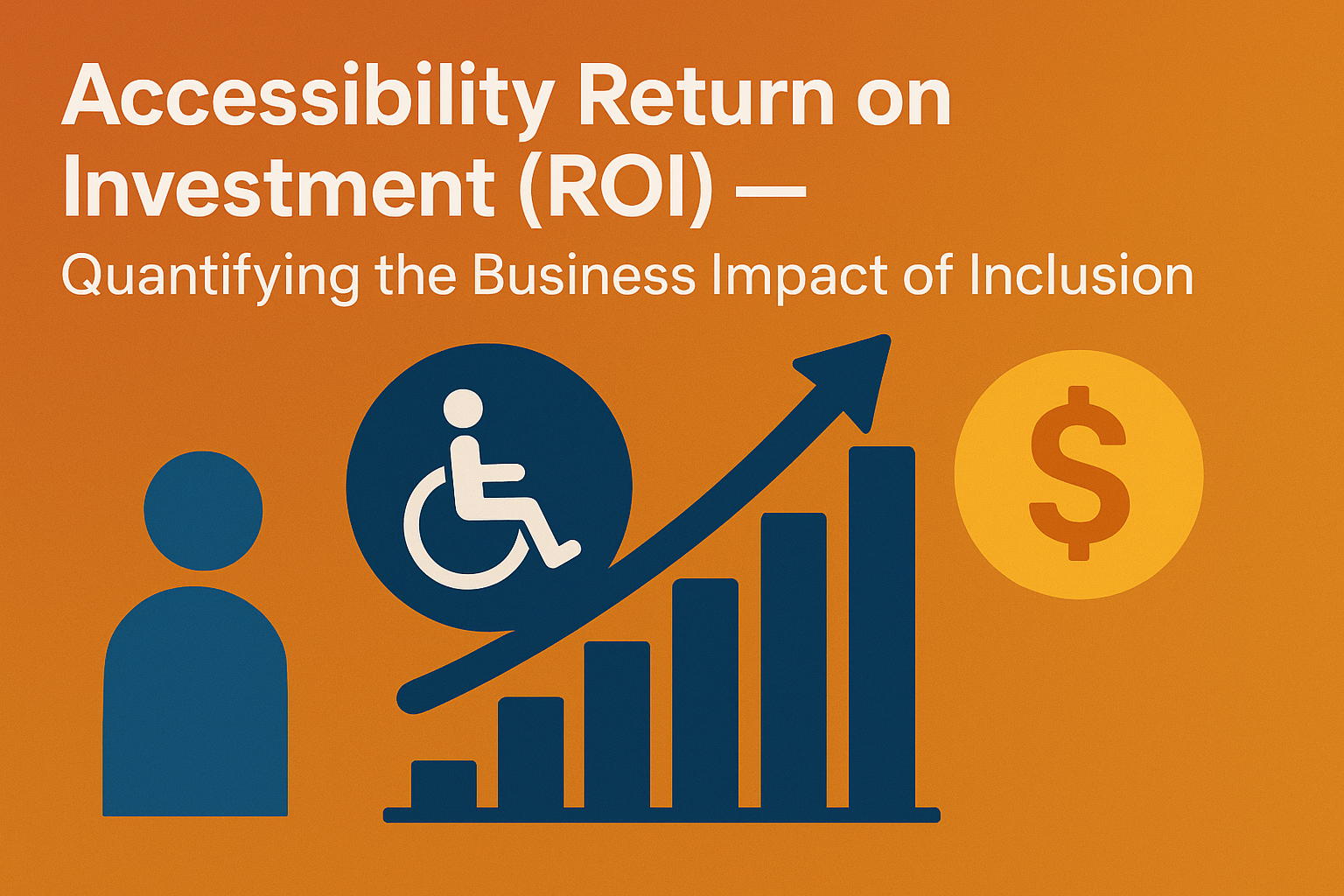
Accessibility Return on Investment (ROI) — Quantifying the Business Impact of Inclusion
Accessibility Return on Investment (ROI) — Quantifying the Business Impact of Inclusion
Introduction
Accessibility is often viewed as a compliance obligation, but in reality, it’s a major business enabler. Inclusive design strengthens brand reputation, increases market reach, reduces risk, and drives innovation that benefits all users. To scale accessibility sustainably, organizations must treat it as an investment with measurable returns — not simply a cost of doing business.
This article breaks down how to assess and communicate the financial and operational ROI of accessibility, helping teams connect inclusion to strategic value and long-term performance.
Why Quantifying Accessibility ROI Matters
- Transforms accessibility from a cost center into a measurable business advantage.
- Secures executive buy-in and sustained investment in accessibility programs.
- Reveals efficiencies gained through early defect prevention and inclusive innovation.
- Aligns accessibility outcomes with organizational KPIs like engagement, retention, and revenue growth.
Core Components of Accessibility ROI
1. Cost Avoidance & Risk Reduction
- Lower legal exposure and settlements from accessibility-related complaints or lawsuits.
- Reduced customer support burden through clearer, more usable experiences.
- Decreased remediation costs by preventing accessibility issues early in design and development.
2. Market Reach & Customer Growth
- Expand reach to the one billion people globally living with disabilities — and the friends and families who influence purchasing decisions.
- Improve brand perception and customer loyalty through inclusive reputation.
- Capture new B2B and government contracts that require accessibility compliance.
3. Operational Efficiency & Innovation
- Reusable accessible components in design systems accelerate development cycles.
- Inclusive design thinking uncovers usability improvements that benefit all users.
- Consistency in accessibility standards reduces QA overhead and rework.
Steps to Calculating Accessibility ROI
Step 1: Define Measurement Scope
Identify the business areas impacted by accessibility — from productivity gains in development to customer conversion improvements. Determine whether you’re measuring ROI for a single project, product portfolio, or organization-wide initiative.
Step 2: Quantify Direct and Indirect Value
- Direct Value: Reduced litigation fees, faster development cycles, lower defect costs.
- Indirect Value: Brand equity, customer satisfaction, innovation, and risk mitigation.
Step 3: Apply ROI Formula
Accessibility ROI = (Total Benefits - Total Costs) / Total Costs × 100%
Where benefits include both tangible (financial savings, new revenue) and intangible (brand trust, employee engagement) value streams.
Step 4: Track Metrics Over Time
- Establish baseline data before accessibility investment.
- Compare improvement trends quarterly or annually.
- Correlate accessibility KPIs with broader business metrics — conversion rates, retention, and satisfaction scores.
Recommended Accessibility ROI Metrics Framework
| Metric | Data Source | Frequency | Goal / Benchmark |
|---|---|---|---|
| Accessibility Defect Prevention Rate | Issue Tracking System | Per Release | ≥ 80% of issues prevented pre‑launch |
| Support Ticket Reduction Due to Usability Fixes | Customer Support Analytics | Quarterly | ≥ 25% decrease after accessibility improvements |
| Customer Retention Rate Among Accessible Products | CRM / Analytics Platform | Quarterly | Above industry average by 5–10% |
| Legal Risk Exposure Reduction | Compliance Reports | Annually | 0 new complaints or settlements |
Communicating ROI to Stakeholders
1. Use Business Language
Translate accessibility outcomes into metrics that executives and investors already value — risk reduction, productivity gain, brand advantage, and market growth.
2. Tell a Quantitative + Qualitative Story
- Combine hard numbers (cost savings, defect reduction) with human impact (user testimonials, engagement improvements).
- Feature case studies where accessibility directly improved KPIs like conversion or retention.
3. Visualize and Report Effectively
- Leverage accessible dashboards for continuous ROI tracking.
- Integrate accessibility metrics into executive scorecards or quarterly reports.
- Highlight return on inclusion alongside traditional financial indicators.
Common Pitfalls
- No baseline measurement: Makes it impossible to demonstrate progress or savings.
- Focusing only on compliance: Misses broader operational and innovation benefits.
- Failing to socialize wins: Success remains invisible if not regularly communicated.
- Underestimating intangibles: Brand goodwill and user trust are critical but often ignored metrics.
Best Practices for Sustaining Accessibility ROI
- Integrate accessibility metrics into business OKRs and performance reviews.
- Invest in accessibility automation and training to maintain cost‑efficiency.
- Regularly benchmark ROI results against peer organizations and industry standards.
- Reinvest accessibility dividends into continuous innovation and user research.
Conclusion
Accessibility ROI is far more than a financial calculation — it’s a reflection of organizational maturity and user empathy. By quantifying the economic and human impact of inclusion, companies can justify ongoing investment and foster a culture where accessibility drives advantage. When inclusion becomes measurable, it becomes sustainable, transformative, and inseparable from innovation itself.
Next Steps: Establish your accessibility ROI framework, collect baseline metrics, and build a dashboard that demonstrates both the financial and human return on designing for everyone.