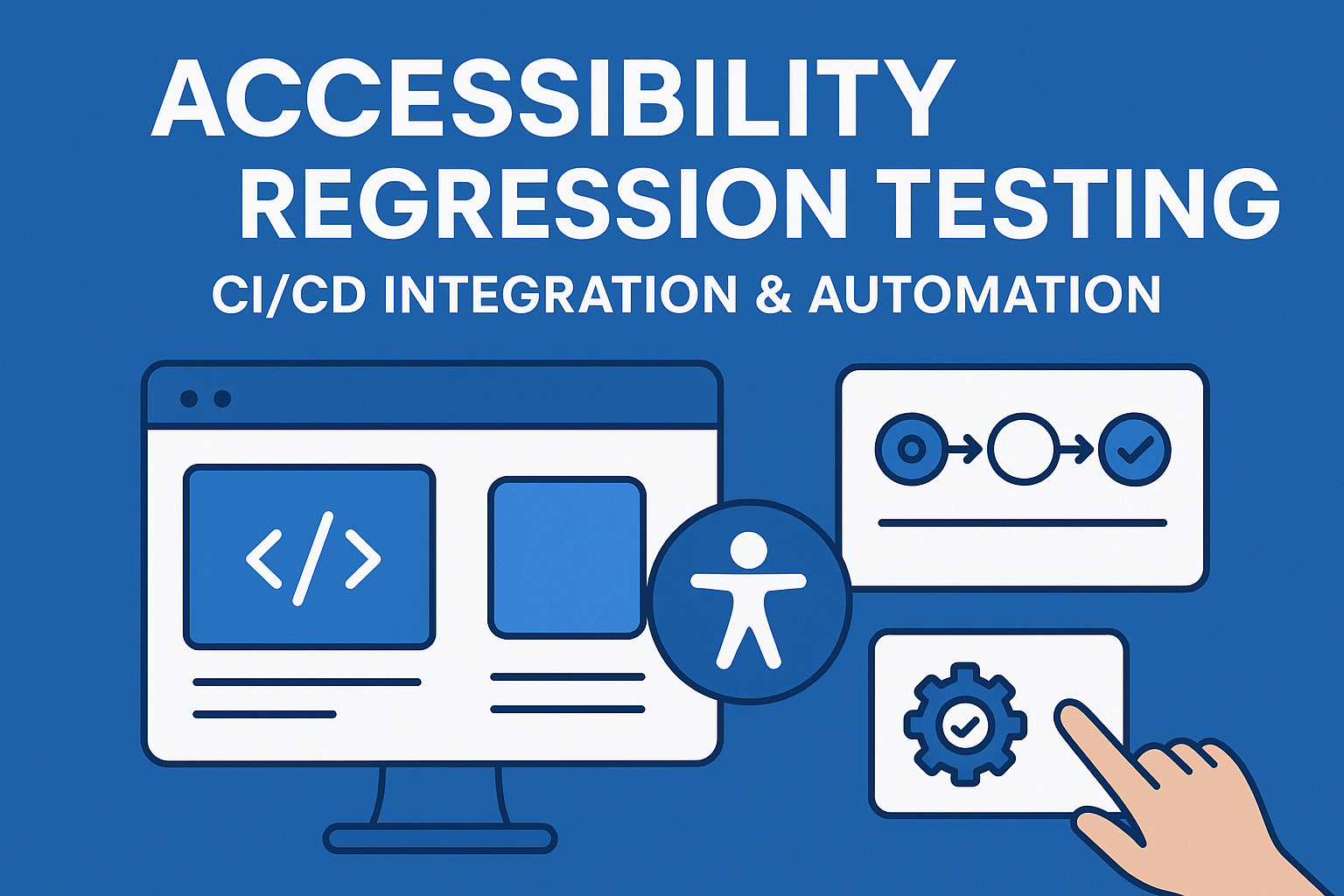
Accessibility Regression Testing — CI/CD Integration & Automation
Accessibility Regression Testing in CI/CD
Introduction
Accessibility shouldn’t be a one‑off activity—it needs to live within your development lifecycle. Regression testing ensures that once accessibility issues are fixed, they stay fixed. By integrating accessibility checks directly into CI/CD (Continuous Integration/Continuous Deployment) pipelines, teams can automatically detect and resolve accessibility regressions before code reaches production.
This continuous approach reduces risk, shortens feedback loops, and embeds inclusive development practices into everyday workflows.
What Is Accessibility Regression Testing?
Accessibility regression testing identifies new or reintroduced accessibility issues after updates, redesigns, or content changes. It complements manual audits by running automated tests at every build or deployment stage.
Automated regression scans can quickly surface errors like:
- Broken heading hierarchies.
- Missing alternate text for new images.
- Low color contrast introduced by theme changes.
- Unlabeled form inputs added during development.
- Dynamic content updates affecting focus behavior.
Benefits of Integrating Accessibility into CI/CD
- Early detection: Identify accessibility issues during the commit or build stage.
- Cost reduction: Fixing defects early is cheaper than post‑launch remediation.
- Consistency: Maintain accessibility quality across releases without manual overhead.
- Scalability: Automated checks cover large codebases quickly.
- Compliance: Demonstrate continuous effort toward WCAG 2.2 AA or Section 508 standards.
Typical CI/CD Accessibility Workflow
- Developer Commit: Code change triggers a pipeline run.
- Automated Scan: Accessibility engine runs static analysis (e.g., axe‑core, pa11y) against updated components or pages.
- Report Generation: Results output as JSON/XML or integrated dashboards.
- Gating Rules: Pipeline fails or warns if severity thresholds are exceeded.
- Remediation & Rerun: Developers fix issues and rerun tests before merge or deploy.
Tools for Accessibility Regression Testing
- axe Core: Open‑source engine powering many automated accessibility frameworks.
- Pa11y CI: Command‑line tool that runs accessibility tests as part of your CI pipeline.
- Google Lighthouse: Integrated in Chrome DevTools; can be automated in Node.js pipelines for scoring accessibility.
- Accessibility Insights: Provides automated checks and detailed guidance for remediation.
- Jest + axe: Unit‑testing‑level accessibility checks for React and other component libraries.
Example Setup: Pa11y CI in a Node.js Project
npm install --save-dev pa11y-ci
{
  "defaults": {
    "standard": "WCAG2AA"
  },
  "urls": [
    "http://localhost:3000/",
    "http://localhost:3000/about"
  ]
}
Then in your CI pipeline configuration (e.g., GitHub Actions, GitLab CI, or Jenkins):
- name: Accessibility Check
  run: npx pa11y-ci
The command scans specified URLs and fails the build if accessibility errors are found.
Integrating with GitHub Actions or GitLab CI
Most modern platforms make accessibility integration straightforward:
- GitHub Actions: Trigger tests on pull requests and push events.
- GitLab CI: Add a dedicated accessibility stage that outputs JSON reports.
- Jenkins: Configure pipeline scripts to run axe‑core mid‑build.
Reports can automatically populate dashboards like Siteimprove or be stored in S3 for compliance logs.
Regression Monitoring Strategies
- Baselines: Compare current builds against previous scan results to highlight new issues only.
- Thresholds: Define acceptable error counts or severity ratings before failing a pipeline.
- Notifications: Send alerts via Slack, email, or ticketing system whenever accessibility regressions occur.
- Trend Reports: Track progress over time across projects or teams.
Manual Verification
Automated regression checks are vital but cannot replace human judgment. Schedule manual spot checks after major design or content changes. Validate:
- Readable link text.
- Proper keyboard navigation and focus management.
- Screen reader announcements for dynamic elements.
Best Practices
- Integrate accessibility testing from the very first sprint rather than retrofitting it.
- Use semantic selectors instead of brittle CSS paths for more stable test results.
- Store historical test data to demonstrate continuous improvement to regulators or clients.
- Combine visual regression and accessibility testing for holistic QA.
Common Pitfalls
- Relying solely on automated checks—manual testing remains crucial for user experience validation.
- Ignoring test failures due to short project timelines.
- Running scans only on production instead of staging environments.
- Lack of defined thresholds or escalation processes for failed tests.
Conclusion
Embedding accessibility regression testing into CI/CD ensures that inclusive design is not a one‑time effort but a continuous quality metric. It helps teams catch issues early, track progress objectively, and maintain ongoing WCAG compliance. Automated accessibility testing supports a culture where accessibility is treated with the same importance as security or performance.
Next steps: Integrate automated scanning tools in your build pipeline, set measurable accessibility thresholds, and continuously validate both code and user workflows across all releases.