Accessibility Overlays — Controversy, Limits & Compliance Risks
Accessibility Overlays: Controversy & Compliance
Introduction
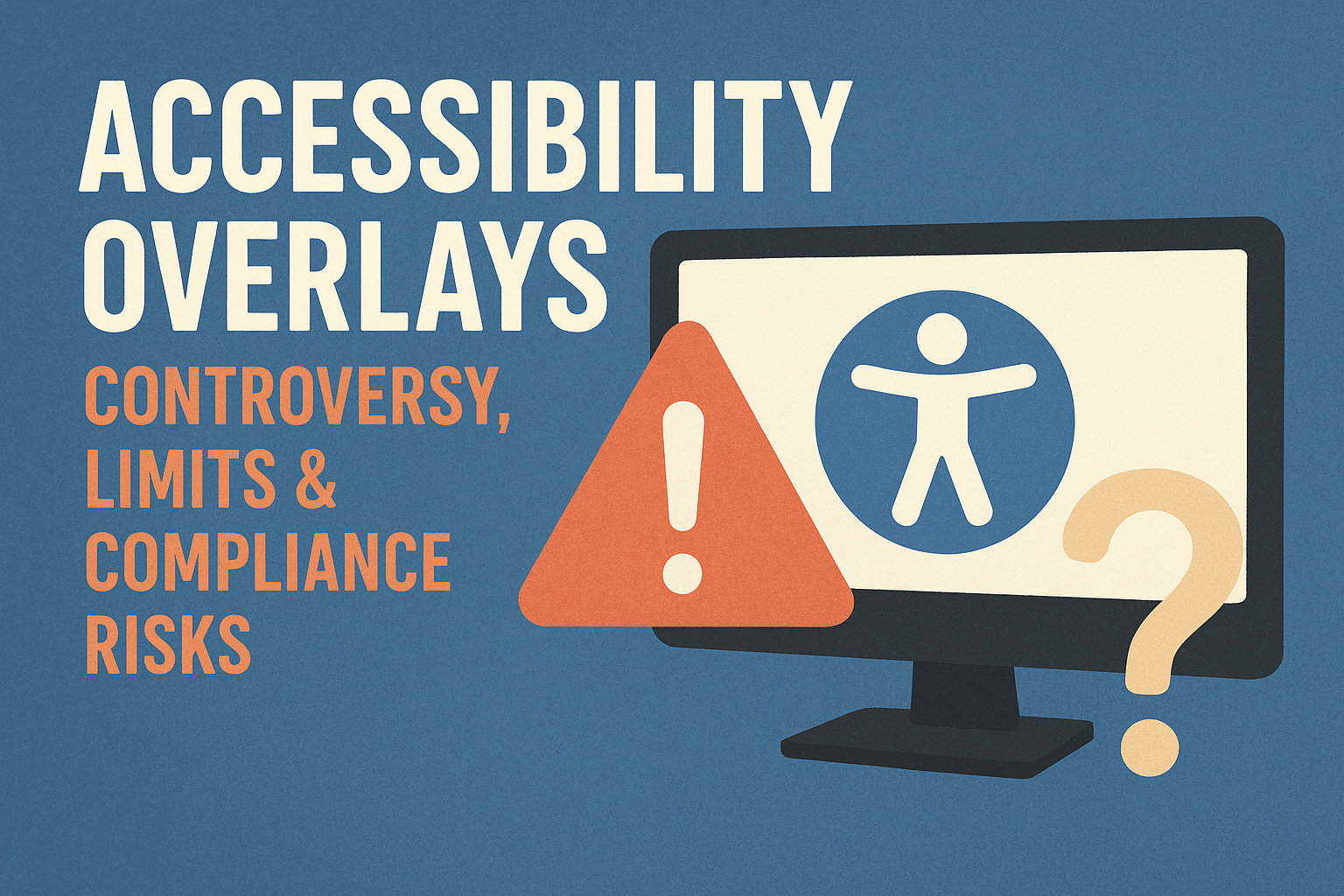
In recent years, a rise in “accessibility overlay” software has promised quick fixes to make websites compliant with accessibility standards. These solutions typically inject JavaScript into websites to modify visual elements automatically—adding screen reader labels, adjusting contrast, or providing customizable UI widgets. However, many accessibility experts caution that such overlays create a false sense of compliance, rarely solving the underlying accessibility barriers in code.
This article explores how overlays work, their perceived advantages, the criticisms against them, and how organizations can mitigate compliance risks by focusing on genuine remediation rather than automated patching.
What Are Accessibility Overlays?
Accessibility overlays—also called “widgets” or “plugins”—are external scripts that attempt to modify page behavior dynamically. They usually include tools for:
- Changing contrast, font size, or text spacing.
- Adding ARIA attributes to elements lacking them.
- Simplifying content layout for improved readability.
- Providing keyboard shortcuts or screen reader enhancements.
While appealing for their ease of implementation, overlays don’t actually fix inaccessible source code. They simply modify what users see or how their assistive tools interface with it temporarily.
Perceived Benefits
Organizations often adopt overlays for these reasons:
- Speed: They can be added quickly via a script, appearing to produce instant improvements.
- Cost Efficiency: Initially cheaper than a full accessibility audit or remediation project.
- Visibility: Widgets show users that accessibility options exist, such as font resizers or dark‑mode toggles.
However, these benefits are short‑term and rarely align with long‑term accessibility best practices.
Why Overlays Are Controversial
Accessibility overlays are widely debated across industries and advocacy groups for several reasons:
1. They Don’t Solve Root Problems
True accessibility requires semantically structured HTML, proper labels, and tested interaction flow. Overlays operate after the page loads, covering up—but not repairing—faulty code.
2. Inconsistent Assistive Technology Support
Overlays can conflict with screen readers by duplicating labels, announcing redundant content, or breaking navigation. The injected code may interfere with native browser and OS accessibility APIs.
3. False Sense of Compliance
Many overlays advertise WCAG or ADA compliance out of the box. In reality, compliance cannot be guaranteed through automation alone—manual testing and remediation remain essential.
4. User Experience Disruption
Overlays may introduce unexpected UI behavior—pop‑ups, menus, or banners—that confuse or frustrate users relying on screen readers or keyboard navigation.
5. Legal Risks
Dozens of lawsuits have cited overlays as insufficient accessibility measures. Courts and advocacy organizations often view them as shortcuts rather than genuine accessibility programs.
Accessibility Community Perspectives
Groups like the National Federation of the Blind (NFB), WebAIM, and Deque Systems have noted that overlays generally fail to meet accessibility expectations. In 2021, over 500 accessibility professionals signed an open letter titled “Overlay Fact Sheet,” emphasizing that overlays do not inherently make sites compliant and can degrade experiences for users of assistive technology.
Compliance & Legal Implications
Under laws such as the ADA and European Accessibility Act, organizations must ensure websites meet WCAG technical standards. Overlays that merely modify front‑end visuals do not equate to compliance if underlying barriers remain.
- Companies that rely solely on overlays risk failing accessibility audits.
- Legal complaints often cite overlays as evidence of neglect rather than remediation.
- Documented user feedback indicating overlay interference may strengthen litigation claims.
Therefore, overlays may give a false impression of due diligence, but courts expect substantive, code‑level conformance.
Better Alternatives to Overlays
1. Full Accessibility Audits
Conduct comprehensive audits by experts using both automated tools and manual testing. This identifies structural issues that overlays can’t address.
2. Code‑Level Remediation
Fix accessibility issues directly in the HTML, CSS, and JavaScript. Improve semantic structure, labels, focus states, and landmarks.
3. Continuous Monitoring & Testing
Integrate automated checks in CI/CD pipelines and run frequent manual tests to prevent regressions.
4. Design System Integration
Embed accessibility rules into design systems and component libraries to ensure issues don’t reappear as products evolve.
When Overlays May Help Temporarily
In some contexts, overlays can provide limited temporary benefits:
- For legacy systems under redevelopment where code access is restricted.
- To offer user‑controlled font or color adjustments as a supplemental assistive feature.
Even then, overlays should accompany—not replace—a broader accessibility strategy with remediation and testing roadmaps.
Best Practices if Using Overlays
- Evaluate overlay features with real assistive technology before deployment.
- Clearly inform users what the overlay controls do.
- Do not disable or override user agent or OS‑level accessibility settings.
- Monitor analytics and feedback for accessibility conflicts.
Industry Trend: From Overlays to Accountability
The accessibility industry is shifting away from “quick‑fix” widgets toward long‑term digital governance. Organizations that once adopted overlays as temporary solutions now invest in full remediation and accessibility training programs. True compliance emerges from structured processes, not scripts.
Conclusion
While accessibility overlays offer the illusion of instant compliance, they cannot replace code‑level accessibility engineering. They may serve short‑term roles but often introduce new usability and legal challenges. Long‑term accessibility requires audits, remediation, and cultural change—ensuring every digital experience is built inclusively from the ground up.
Next steps: If your organization currently uses an accessibility overlay, assess its real impact. Conduct an independent accessibility audit, create a remediation plan, and treat overlays only as temporary enhancements—not permanent compliance solutions.