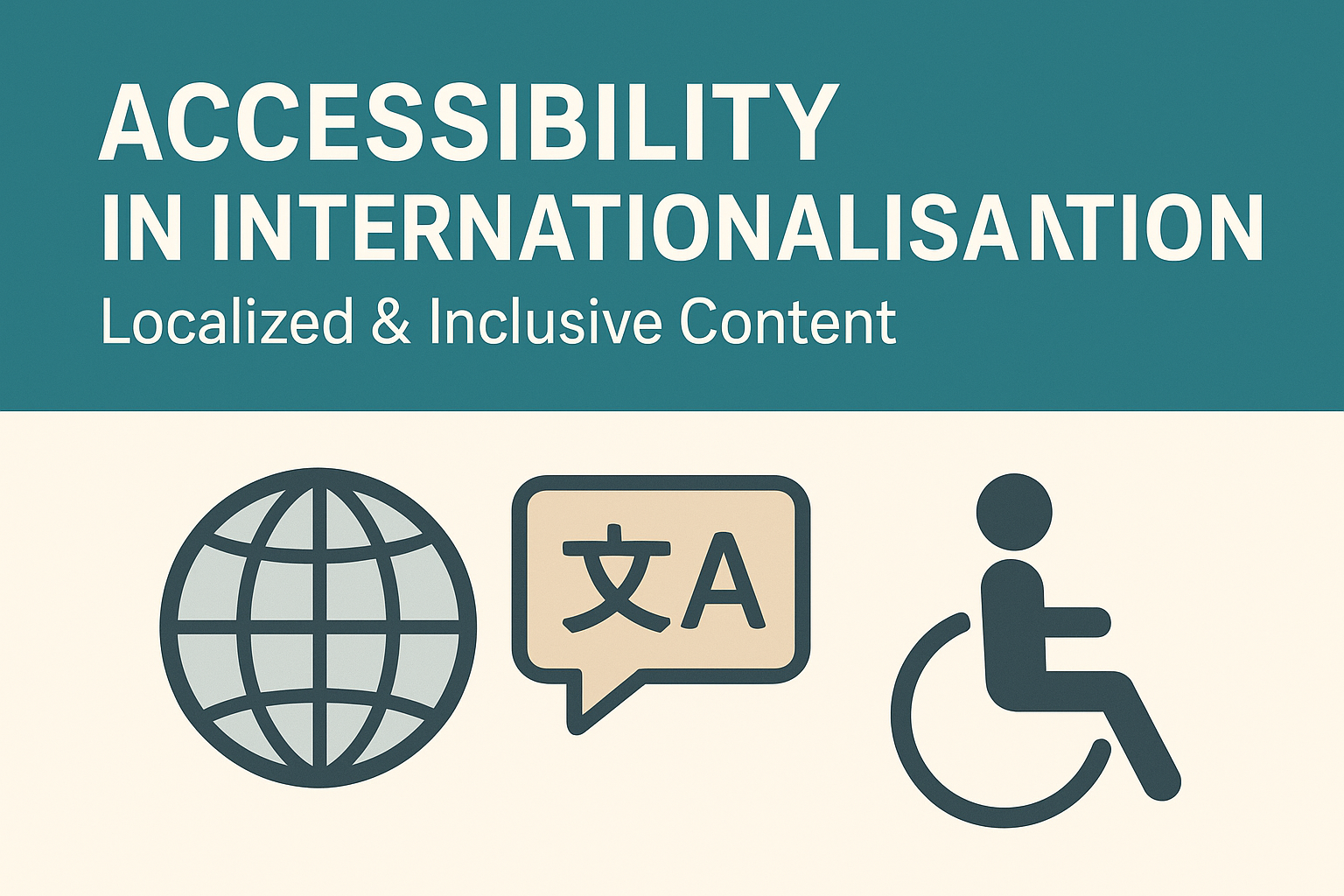
Accessibility in Internationalisation — Localized & Inclusive Content
Accessibility in Internationalisation & Localisation
Introduction
As products and services expand globally, accessibility must extend beyond language translation. Internationalisation (i18n) and localisation (l10n) customize digital content for different languages, regions, and cultures. Accessibility ensures that localized experiences remain usable for everyone — including users with disabilities who rely on assistive technologies in their native language.
Accessible localisation considers linguistic, cultural, and technical nuances to maintain usability and compliance with international standards like WCAG 2.2, ISO 9241‑171, and local regulations such as the European Accessibility Act or EN 301 549.
Why Accessibility Matters in Global Contexts
- Ensures equal access for users worldwide, regardless of language or ability.
- Maintains brand consistency and inclusiveness across regions.
- Helps satisfy local legal requirements that mirror or extend WCAG.
- Strengthens trust and usability for multilingual audiences.
True accessibility transcends language barriers — it creates equitable digital experiences in every context.
Challenges in Localized Accessibility
- Translation Accuracy: Misinterpreted terms for labels or ARIA descriptions can break meaning for screen reader users.
- Text Expansion: Some languages require more characters, which can disrupt design or spacing.
- Right‑to‑Left (RTL) Support: Arabic, Hebrew, and Persian interfaces require mirrored layouts and correct reading order.
- Date & Format Variations: Forms and inputs must adapt to locale conventions (e.g., DD/MM/YYYY vs MM/DD/YYYY).
- Cultural Imagery & Color Use: Symbols and colors may have different meanings or accessibility implications across regions.
WCAG & International Standards Alignment
Most countries adopting accessibility legislation reference or adapt WCAG principles. Internationalisation teams should ensure these fundamentals are upheld across markets:
- WCAG 2.2 AA: Global benchmark for web accessibility.
- EN 301 549: EU standard enforcing accessibility for public‑sector ICT products.
- Section 508 (U.S.): Applies to government and contractor services.
- JIS X 8341 (Japan): National web accessibility guidelines.
The goal is to harmonize technical compliance with linguistic and cultural relevance.
Accessible Internationalisation Best Practices
1. Maintain Semantic Structure in All Languages
Translated content must preserve headings (<h1>–<h6>), lists, and landmarks. Screen readers depend on consistent structure for navigation, regardless of language.
2. Localize ARIA Labels & Alternative Text
Translate all non‑visible text used by assistive technologies — including alt attributes, aria-label, and error messages. Verify translations with native speakers to ensure contextual correctness.
3. Adapt Reading Direction & Layout
For right‑to‑left scripts:
- Use
dir="rtl"and logical mirroring for navigation patterns. - Align text, UI components, and icons appropriately for reading flow.
4. Adjust Dynamic & Interactive Content
Ensure live regions, notifications, and validation errors are announced correctly in localized versions. Use screen reader testing for each locale to validate pronunciation and ordering.
5. Provide Locale‑Specific Keyboard Shortcuts
Shortcuts involving letters may conflict with local keyboards. Offer customizable shortcuts that adapt to various layouts and input methods.
Design & Language Considerations
- Readable Fonts: Choose typefaces supporting full multilingual character sets, including accented letters and RTL glyphs.
- Color & Symbol Sensitivity: Check that icons and color usage remain culturally appropriate and maintain accessibility contrast ratios everywhere.
- Plain Language: Translate content into clear, concise text that meets local literacy norms and cognitive accessibility needs.
- Error Messaging: Provide localized error explanations, not just code references—users must understand what went wrong in their language.
Testing Accessibility Across Locales
- Involve native-language accessibility testers wherever possible.
- Test focus order and reading flow in RTL contexts.
- Verify screen reader output using localized software voices (e.g., NVDA with locale plugins, VoiceOver, TalkBack).
- Automate accessibility checks across language versions using axe‑core or Pa11y with locale‑specific site maps.
Common Pitfalls
- Translation omitting necessary ARIA attributes or alt text.
- Ignoring cultural implications of imagery or metaphors.
- Breaking layouts with text expansion or RTL alignment.
- Hard‑coding direction or font that lacks multilingual support.
- Failing to validate local color choices for proper contrast ratios.
Benefits of Accessible Localisation
- Greater reach and trust among international users with disabilities.
- Consistent brand voice while respecting cultural and linguistic diversity.
- Improved compliance with regional accessibility laws.
- Enhanced SEO and discoverability across multilingual markets.
Conclusion
Accessibility must remain consistent across every localized experience. By aligning WCAG principles with linguistic and cultural best practices, organizations can reach global users equitably while strengthening legal compliance and brand reputation.
Next steps: Audit localized sites for structural and linguistic accessibility, test interfaces with native assistive technology, and build translation workflows that include accessibility review as a standard step.