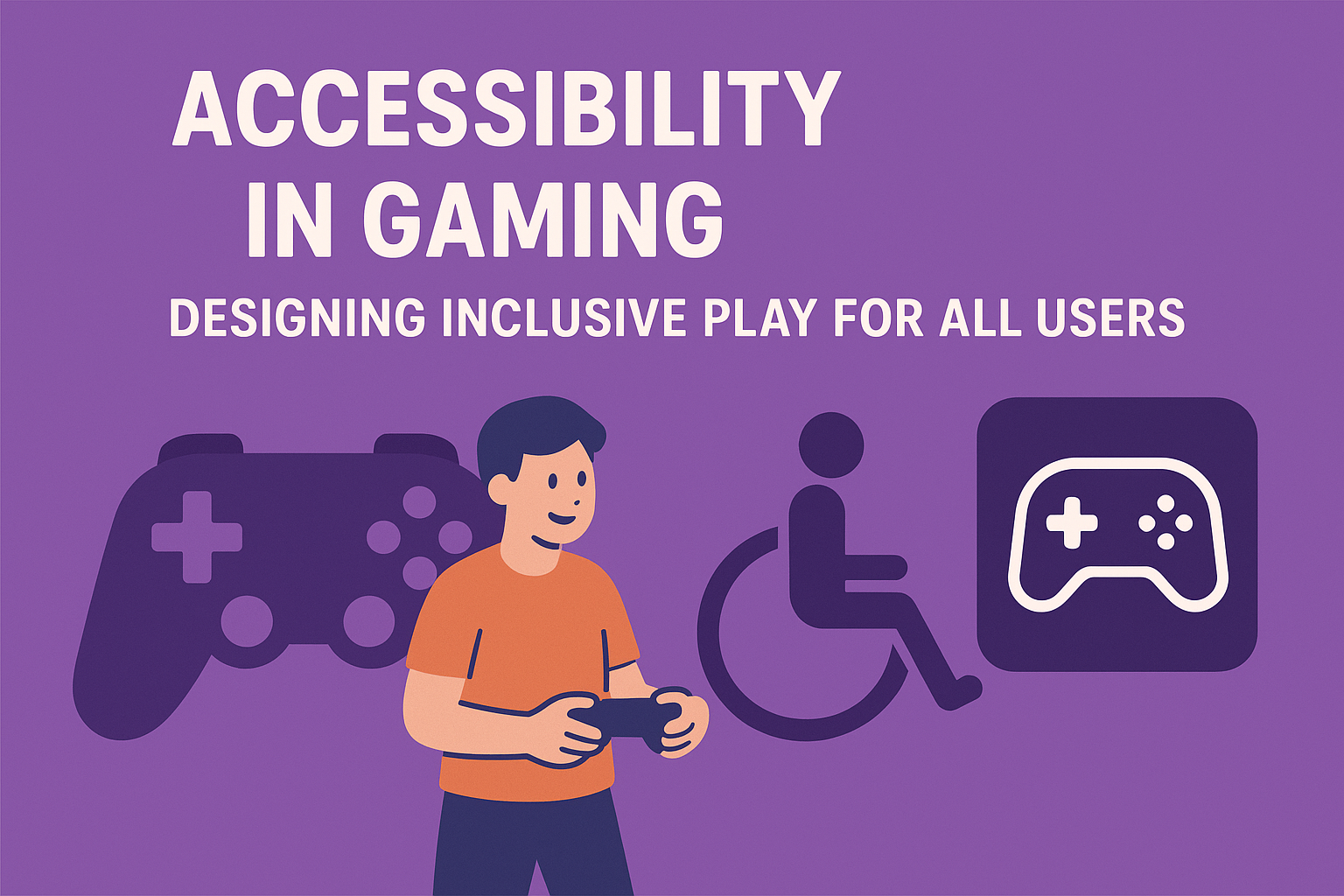
Accessibility in Gaming — Designing Inclusive Play for All Users
Accessibility in Gaming — Designing Inclusive Play for All Users
Introduction
Gaming is one of the most immersive forms of digital experience, allowing players to interact, explore, and connect worldwide. However, many games still exclude players with disabilities due to inaccessible controls, visuals, or sound design. Inclusive gaming design ensures that everyone can experience the joy of play — regardless of ability. By embedding accessibility from concept to launch, developers can create games that engage a wider audience while meeting global inclusion standards.
This article explores principles, patterns, and best practices for accessible game design, drawing from the Game Accessibility Guidelines (GAG), WCAG 2.2, and input from disabled gamers and advocates.
Why Accessibility in Gaming Matters
- Games provide community, education, and emotional enrichment — accessibility ensures equal entry to those spaces.
- Approximately 15–20% of players identify as disabled (UK and US data sources), representing millions of potential players.
- Accessible titles like Forza Horizon, The Last of Us Part II, and Halo Infinite have proven that inclusion and innovation go hand in hand.
Foundations of Accessible Game Design
1. Input Accessibility
Control flexibility is crucial for players with different mobility, dexterity, and sensory needs.
- Allow full control remapping (keyboard/mouse, controller mapping or touch customization).
- Support adaptive controllers like Microsoft Adaptive Controller or custom input device APIs.
- Include toggle instead of hold mechanics for reducing fatigue (e.g., aim down sight or running functions).
- Offer multiple interaction methods (voice, eye tracking, assistive devices, one‑switch controls).
2. Visual Accessibility
Clarity is essential for users with low vision, color blindness, or photosensitivity.
- Provide built‑in color‑blind modes (deuteranopia, protanopia, tritanopia).
- Ensure sufficient contrast between UI labels and backgrounds (4.5:1 minimum).
- Include customizable font size and HUD (scale UI, crosshairs, subtitles separately).
- Avoid rapid flashing elements exceeding 3 flashes per second (WCAG 2.3.1).
- Offer visual alternatives for audio cues (such as dialogue direction or enemy alerts).
3. Audio Accessibility
- Include captions and subtitles for all spoken dialogue and important sound effects.
- Provide volume mixing options (music, voice, effects separately).
- Support speech‑to‑text for chat and text‑to‑speech for menus or messages.
- Use 3D audio spatialization to help with orientation where appropriate.
Game Interface & UI Design
User interface (UI) is the bridge between gameplay and comprehension — accessible UIs make engagement effortless.
- Include navigable menus using keyboard or controller only.
- Maintain focus states for selection highlight and orientation feedback.
- Support screen reader and narrator compatibility on PC and console systems.
- Expose text elements and menu descriptions as readable UI labels through accessibility APIs.
- Provide tutorials or practice modes with slow progression for players learning assistive controls.
Motion & Cognitive Accessibility
- Offer “reduce motion” modes to limit field of view (FOV) shifts and camera shake.
- Include game speed sliders or pause options for reaction‑based tasks.
- Provide simplified UI modes and visual guidance for players with cognitive differences.
- Use plain‑language instructions and symbol reinforcement icons for clarity.
Multiplayer & Social Accessibility
- Implement voice modulation and captioned chat for inclusive communication.
- Provide moderation tools to protect players from harassment or ableist language.
- Show status icons for communication preferences (e.g., voice, text only, ASL stream).
- Support cross‑platform accessibility settings so users don’t need to reconfigure every device.
Testing Accessibility in Games
Testing requires collaboration with disabled players and community groups to ensure authentic feedback.
- Conduct user research with players using assistive devices.
- Use automated and manual QA testing for text clarity, color contrast, and input mapping.
- Consult the Game Accessibility Guidelines for checklists by severity (basic, intermediate, advanced).
- Involve accessibility consultants throughout development rather than pre‑launch only.
Common Barriers in Games
- Fixed control schemes: Players cannot customize inputs or remap buttons.
- No text alternatives: Critical information only shown via color or sound.
- Complex menus: Poor hierarchy and lack of narration make navigation impossible for screen reader users.
- Missing captions or contrast: Dialogue and UI elements unreadable on small screens.
Best Practices
- Plan accessibility from the concept phase — never as a post‑production fix.
- Use universal symbols and standards for settings menus (e.g., subtitle on/off iconography).
- Document and publish accessibility features for players (pre‑purchase transparency).
- Collaborate with disabled gamers during playtesting and early UX validation.
Conclusion
Accessible gaming unlocks creativity and community for all players. By designing inclusive inputs, interfaces, and narratives, developers can transform games into experiences where everyone belongs. Accessibility and innovation move together — when barriers fall, play becomes universal.
Next Steps: Audit your game against Game Accessibility Guidelines, provide configuration for controls and display modes, and establish a testing initiative with the disabled gaming community to continuously improve accessibility features.