Accessibility Certification & Auditing — Services Explained
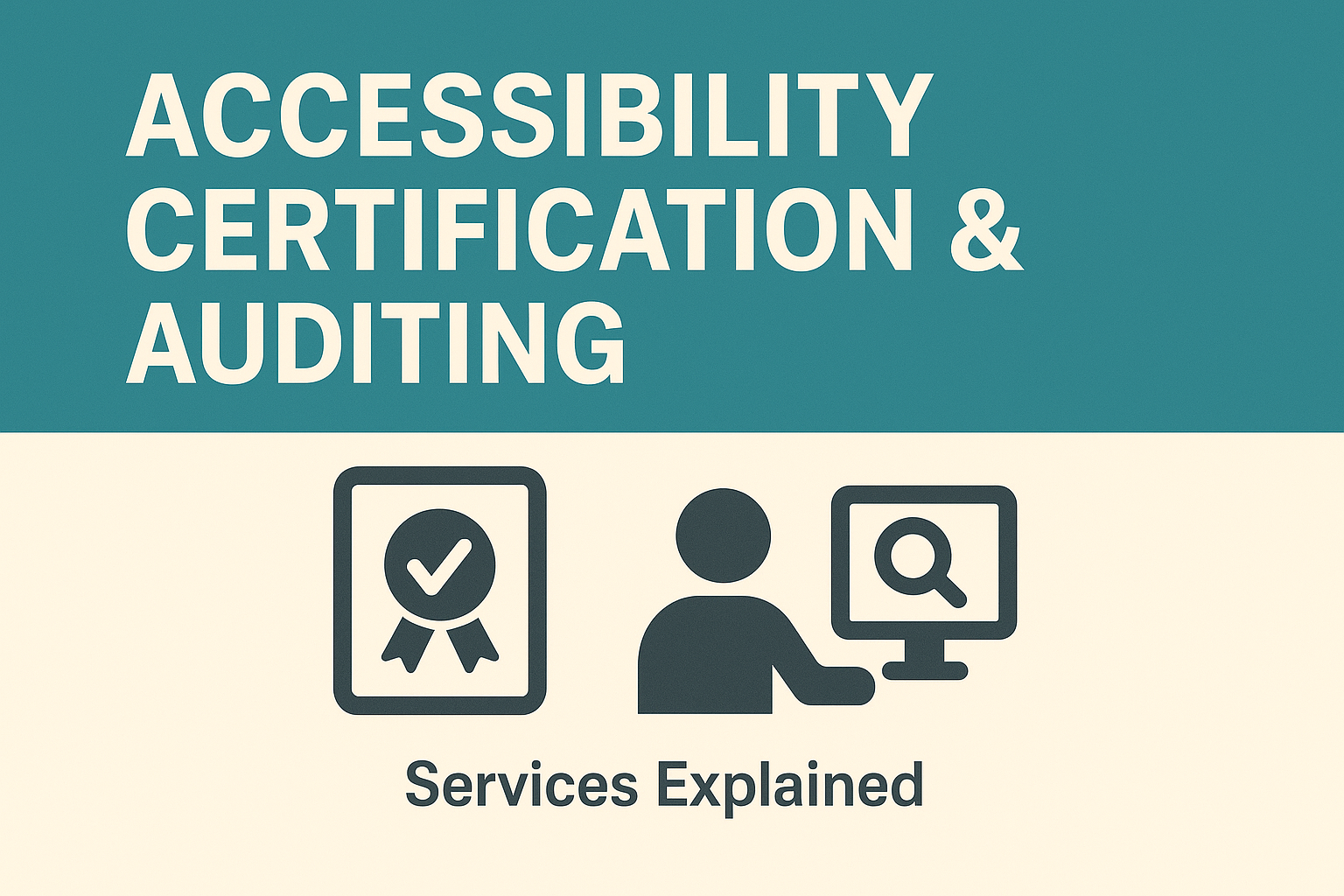
Accessibility Certification & Auditing Services
Introduction
Accessibility certification and auditing services provide organizations with professional verification of their compliance with standards such as the WCAG 2.2, Section 508, and the European Accessibility Act (EAA). These services combine automated testing, manual expert review, and user testing with assistive technologies to ensure digital properties meet accessibility requirements and are usable for everyone.
A proper accessibility audit goes beyond pass/fail reports — it analyzes usability barriers, prioritizes remediation, and establishes trust with customers and regulators. Many organizations pursue certification as part of procurement policies, product launches, or public accountability initiatives.
What Is an Accessibility Audit?
An accessibility audit is a comprehensive review of a website, mobile app, or software product against recognized accessibility criteria. It documents issues that prevent compliance and impacts user experience for people with disabilities.
Audit Components:
- Automated Testing: Uses tools like axe, WAVE, or Lighthouse to detect machine‑measurable issues such as missing alt text or low contrast.
- Manual Review: Human testers verify structure, semantics, and ARIA usage that tools cannot evaluate accurately.
- User Testing: Involves people with disabilities navigating and completing tasks with assistive technology.
Together, these methods produce an accurate picture of both technical and experiential accessibility.
Certification vs. Audit: Understanding the Difference
- Accessibility Audit: Diagnostic process identifying issues and improvements.
- Accessibility Certification: Official or third‑party validation that a product conforms to specific standards after testing and remediation.
Audits are ongoing tools for improvement, while certifications reflect attainment of compliance at a point in time. Most organizations perform audits first, then apply for certification.
Common Standards for Certification
- WCAG 2.1 / 2.2 Level AA: Global standard for web accessibility.
- Section 508 (U.S.): Federal conformance requirement for digital content and technology.
- EN 301 549 (EU): European accessibility standard referenced in the EAA.
- PDF/UA (ISO 14289): Accessible document standard for tagged PDFs.
- ISO/IEC 40500: International standardization of WCAG 2.0.
The Audit Process Step‑by‑Step
- Scoping: Define what needs auditing — websites, apps, intranets, or documents.
- Automated Scan: Identify baseline technical issues for triage.
- Manual Testing: Evaluate navigation, landmarks, keyboard flow, and focus management.
- Assistive Technology Testing: Run user flows using NVDA, VoiceOver, JAWS, or TalkBack.
- Reporting: Document issues, affected WCAG criteria, and remediation recommendations.
- Remediation & Verification: Re‑test after fixes to confirm compliance.
Audit Deliverables
- Detailed WCAG failure matrix mapped to Level A/AA/AAA criteria.
- Annotated screenshots or code references of each issue.
- Severity ranking (Critical → Minor) with fix priorities.
- Compliance summary for stakeholders or legal documentation.
- Accessibility statement templates for publication.
Choosing Accessibility Service Providers
When selecting a certification or audit provider, evaluate the following:
- Expertise & Reputation: Confirm auditors have certified accessibility specialists (e.g., IAAP CPACC or WAS certifications).
- Manual Focus: Choose providers emphasizing human testing with AT users, not just automated scans.
- Transparency: Ask about methodologies and tools used.
- Remediation Support: Providers should guide your team with actionable, prioritized recommendations.
- Confidentiality & Legal Standing: Ensure the audit report is recognized for compliance purposes or legal defense documentation.
Voluntary Product Accessibility Template (VPAT)
A VPAT is a standardized document summarizing conformance to Section 508 or EN 301 549 requirements. It’s widely used in US and EU procurement to prove accessibility credentials.
- Certification partners can help create and verify a VPAT report.
- It communicates accessibility status to clients and regulators in a structured format.
- Having an up‑to‑date VPAT enhances trust and procurement readiness.
Auditing Tools & Frameworks
- axe Core — industry‑standard automated testing framework
- WAVE Evaluation Tool — browser‑based interactive analysis
- Accessibility Insights — manual guided audit features by Microsoft
- Pa11y — Node.js CI testing
- WebAIM Contrast Checker — color ratio testing
Benefits of Accessibility Certification
- Demonstrates measurable conformance and credibility to stakeholders and customers.
- Reduces legal risk under ADA, EAA, and Section 508.
- Provides a marketing and reputation edge in inclusive product development.
- Enhances usability and quality for all users, not just those with disabilities.
- Establishes benchmarks for ongoing governance and maintenance.
Common Pitfalls to Avoid
- Relying solely on automated audits without manual testing.
- Failing to address findings or validate after remediation.
- Assuming certification is permanent — it requires periodic re‑evaluation.
- Not including real users with disabilities in testing processes.
Maintaining Compliance After Certification
Accessibility must be treated as a continuous improvement process.
Set regular audit repeats (e.g., annually or after major updates) and train teams to embed accessibility into SDLC (workflows, design systems, and QA testing pipelines).
Combine automated monitoring with manual spot checks between formal audits.
Conclusion
Certification and auditing validate that your poduct meets recognized accessibility standards while building trust with customers, regulators, and employees. True compliance is achieved when audits drive long‑term remediation and inclusive design practice within your organization.
Next steps: Schedule an accessibility audit with a qualified provider, address critical findings, and use the results to pursue formal certification and continuous compliance governance.