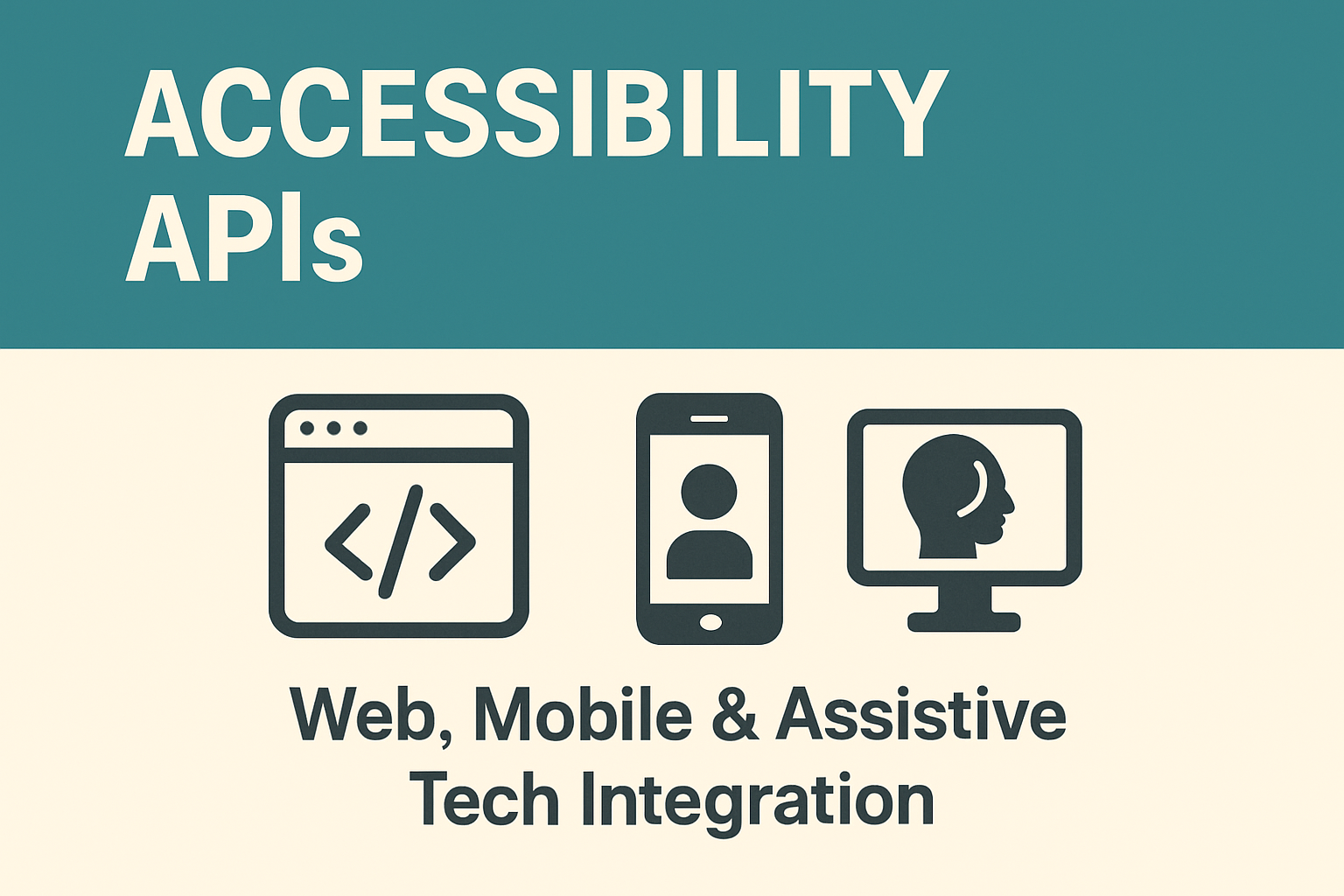
Accessibility APIs — Web, Mobile & Assistive Tech Integration
Accessibility APIs: Web, Mobile & Assistive Tech Integration
Introduction
Accessibility Application Programming Interfaces (APIs) are the bridge between user interfaces and assistive technologies. They make digital content perceivable and operable by exposing an application’s structure, semantics, and state information to tools like screen readers, magnifiers, and voice controls.
Understanding how accessibility APIs work enables developers to build more inclusive software across web, iOS, Android, and desktop environments. This guide explores how these APIs interact with content, how ARIA ties into web accessibility APIs, and key best practices for ensuring smooth integration.
What Are Accessibility APIs?
An accessibility API defines how applications communicate accessibility information to assistive technologies (AT). It exposes element roles, names, states, and hierarchies so AT can describe and control the interface for users with disabilities.
Essentially, accessibility APIs act as translators between DOM code (or native app elements) and assistive tools, ensuring your app’s structure and interactions are perceivable and operable.
How Accessibility APIs Work
- The UI framework (like HTML or UIKit) maps interface elements to the appropriate accessibility API.
- Each element exposes metadata: role, name, description, and state.
- Assistive technologies consume that data to generate audible, tactile, or visual representations.
For example, a <button> on the web is mapped via the platform API to announce itself as a clickable control through screen readers such as NVDA or VoiceOver.
Web Accessibility APIs
1. Microsoft UI Automation (UIA)
Microsoft’s UIA interface underlies accessibility in Windows apps and browsers (Edge). It provides programmatic access to controls, properties, and events for AT like screen readers and automated testing tools.
2. Apple Accessibility API (AX API)
macOS and iOS browsers translate web elements to Apple’s Accessibility API, which interprets semantic HTML and ARIA attributes for VoiceOver and other tools.
3. ATK/AT‑SPI (Linux)
Linux platforms communicate accessibility information through the Accessibility Toolkit (ATK) and the Assistive Technology Service Provider Interface (AT‑SPI), commonly used with Orca screen reader.
4. The ARIA Bridge
Accessible Rich Internet Applications (ARIA) acts as the developer layer that augments HTML with roles and attributes. ARIA content is mapped to the system’s underlying API (UIA, AX, or ATK) enabling consistent interpretation.
Mobile Accessibility APIs
Apple iOS Accessibility (UIAccessibility)
- Framework: UIKit exposes accessibility elements like labels, traits, and hints.
- Developers use properties such as
accessibilityLabel,accessibilityHint, andisAccessibilityElement. - VoiceOver consumes this information to narrate content.
imageView.isAccessibilityElement = true
imageView.accessibilityLabel = "Product photo of running shoes"
imageView.accessibilityHint = "Double tap to open gallery"
Android Accessibility (AccessibilityNodeInfo)
- Framework: The Android Accessibility API surfaces content via AccessibilityNodeInfo, enabling screen readers (TalkBack) to describe UI elements.
- Attributes include
contentDescription, role (hierarchy), and state (enabled, checked, etc.).
myButton.setContentDescription("Submit registration form");
Android Jetpack provides Compose Accessibility APIs for declarative UI development that directly integrate with TalkBack.
Common Roles & Properties Exposed via Accessibility APIs
- Name: What the element is called (visible text, or aria‑label).
- Role: Its function (button, link, text field, checkbox).
- State: Whether it’s checked, selected, collapsed, disabled, etc.
- Description: Supplementary context like hints or help text.
- Relationships: Parent/child associations of UI elements.
Ensuring Effective Integration
1. Use Native Controls Where Possible
Native HTML or OS controls automatically connect to underlying accessibility APIs, preventing the need for extra ARIA or manual configuration.
2. Keep Semantics Intact
Ensure that ARIA roles accurately represent behavior. Avoid overwriting native semantics unless necessary (e.g., don’t assign role="button" to an actual <button>).
3. Manage Dynamic Content
Use aria-live and platform announcement APIs (like UIAccessibility.post(notification: .announcement)) to keep users informed during dynamic state changes.
4. Verify Properties on All Platforms
- Run screen readers to check that role and name are announced properly.
- Inspect accessibility trees using developer tools:
- Chrome DevTools → Accessibility pane.
- Xcode → Accessibility Inspector.
- Android Studio → Layout Inspector > Accessibility Scanner.
Testing Tools
- Chrome Accessibility Tree Viewer
- Apple Accessibility Inspector
- Android Accessibility Scanner
- Accessibility Insights
Testing ensures all information is correctly exposed through APIs to assistive technologies.
Common Pitfalls
- Custom controls built without proper ARIA mappings.
- Duplicate or conflicting ARIA labels causing redundancy in screen readers.
- Dynamic elements not updating their accessible state (for example, missing aria‑expanded changes).
- Neglecting cross‑platform testing — working on web but not mobile.
Benefits of Understanding Accessibility APIs
- Consistent accessibility experiences across platforms.
- Improved AT compatibility and user satisfaction.
- Stronger compliance with WCAG and local standards.
- Early issue detection during development, reducing remediation costs.
Conclusion
Accessibility APIs are the backbone of digital inclusion. They connect your UI code to assistive technologies, ensuring equal access across devices. Developers who understand and test these APIs can build products that remain usable, compliant, and adaptable in every environment.
Next steps: Inspect your application’s accessibility tree, map missing ARIA roles to native semantics, and validate accessibility API output in screen readers across web, iOS, and Android.